
Understand the decision
Some visits lose referrer information and some decisions happen without a click. Treat attribution as partial rather than claiming a complete path for every customer.
Specify a linked citation, an unlinked mention, an identifiable referral session and a qualified enquiry. Keep a record of the numerator and denominator for each reported rate.
A practical workflow
Work through the sequence below. Keep the evidence, the change you make and the acceptance check together so the next person can understand the decision.
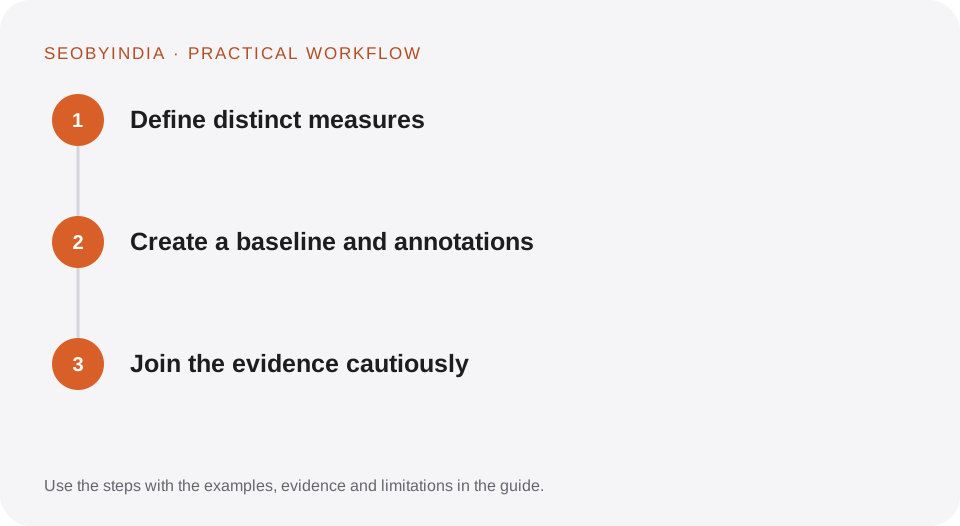
Define distinct measures
Specify a linked citation, an unlinked mention, an identifiable referral session and a qualified enquiry. Keep a record of the numerator and denominator for each reported rate.
Create a baseline and annotations
Record the query set and analytics setup before major changes. Annotate new pages, outreach coverage and tracking changes so later comparisons remain interpretable.
Join the evidence cautiously
Look for agreement between citation observations, relevant visits and customer feedback. Explain uncertainty where the sources do not connect directly. Use optional enquiry-source questions without making them a forced attribution system.
Illustrative scenario
What this looks like in practice
A business receives identifiable ChatGPT referral visits and a prospect mentions an AI recommendation on a call. Report the tracked visits and the self-reported enquiry separately instead of treating them as a complete conversion funnel.
This is a worked example, not a claim about a client campaign or a promised result.
Before you sign it off
Do not label all direct traffic as AI traffic. Avoid comparing a newly expanded query sample with a smaller old one without adjusting the report.
Keep a useful decision record
- Purpose
- Write the customer task this change is meant to improve.
- Evidence
- Save the relevant page, source or observation and its date.
- Owner
- Identify who implements the change and who verifies it.
- Acceptance
- State what a correct result looks like before measuring its wider effect.
What to measure
Use fixed-sample citation rates, identifiable referrals, engaged task completion and qualified leads, with the reporting limitations beside the figures.
Record the baseline and the observation window. If the measurement setup changes, annotate the report before comparing periods. Use the findings to choose the next useful improvement, rather than treating one encouraging result as proof of a permanent outcome.
Sources and further reading
These primary references provide platform guidance and context. The workflows and scenarios on this page are editorial explanations; a source link does not turn an example into a measured result.
Need help applying this?
Start with your website, target audience and the problem you want to solve. We can agree on the useful work, implementation responsibilities and reporting.
Explore the relevant serviceDiscuss the scope