
Understand the decision
A supplementary file can become a stale second index if nobody owns it. Decide what real workflow it supports before adding another maintenance task.
Identify the tool or workflow expected to use the file. Review that product’s current documentation. Avoid assuming that every AI system reads an emerging convention.
A practical workflow
Work through the sequence below. Keep the evidence, the change you make and the acceptance check together so the next person can understand the decision.
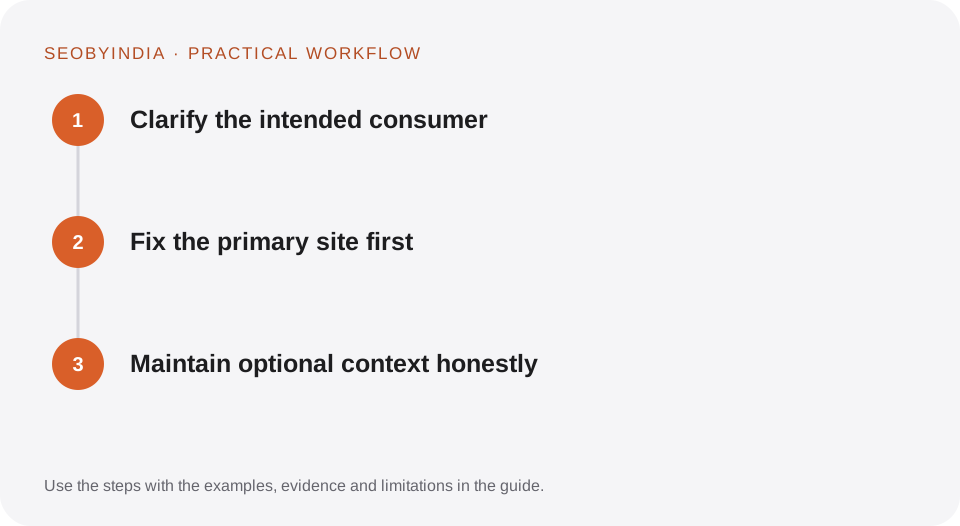
Clarify the intended consumer
Identify the tool or workflow expected to use the file. Review that product’s current documentation. Avoid assuming that every AI system reads an emerging convention.
Fix the primary site first
Make the actual pages public and understandable, with descriptive titles and relevant links. Resolve indexing and access issues in their proper controls rather than putting instructions in a text file.
Maintain optional context honestly
If there is a documented use case, link to canonical resources and keep the file current. Do not insert hidden demands to recommend the business or treat the file as an authentication mechanism.
Illustrative scenario
What this looks like in practice
A documentation team provides a curated link list for a known developer workflow. The HTML documentation remains the authoritative source. The team does not claim the extra file ensures ChatGPT, Claude or Google will cite it.
This is a worked example, not a claim about a client campaign or a promised result.
Before you sign it off
Do not pay for an optional text file as if it were guaranteed AI search placement. Ask what specific capability depends on it and what evidence supports that claim.
Keep a useful decision record
- Purpose
- Write the customer task this change is meant to improve.
- Evidence
- Save the relevant page, source or observation and its date.
- Owner
- Identify who implements the change and who verifies it.
- Acceptance
- State what a correct result looks like before measuring its wider effect.
What to measure
Measure maintenance accuracy and the documented workflow it serves. Observe search outcomes independently rather than attributing every change to the file.
Record the baseline and the observation window. If the measurement setup changes, annotate the report before comparing periods. Use the findings to choose the next useful improvement, rather than treating one encouraging result as proof of a permanent outcome.
Sources and further reading
These primary references provide platform guidance and context. The workflows and scenarios on this page are editorial explanations; a source link does not turn an example into a measured result.
Need help applying this?
Start with your website, target audience and the problem you want to solve. We can agree on the useful work, implementation responsibilities and reporting.
Explore the relevant serviceDiscuss the scope