
Understand the decision
Readers need to distinguish a platform rule, an observed result, an estimate and an illustrative example. Those categories carry different levels of certainty.
Mark whether it is a documented requirement, a measured observation, professional judgement or a hypothetical example. Remove precise claims that have no defensible basis.
A practical workflow
Work through the sequence below. Keep the evidence, the change you make and the acceptance check together so the next person can understand the decision.
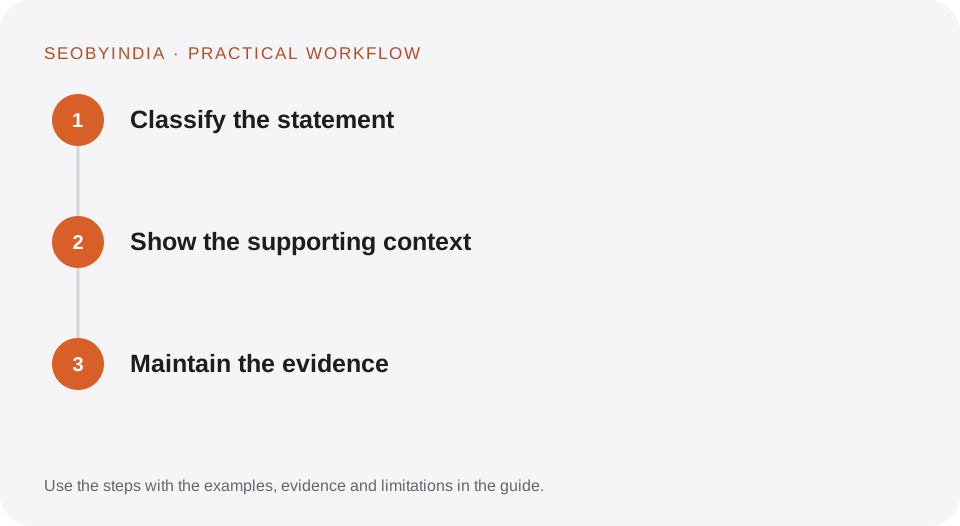
Classify the statement
Mark whether it is a documented requirement, a measured observation, professional judgement or a hypothetical example. Remove precise claims that have no defensible basis.
Show the supporting context
Link primary documentation and include dates or methods where they matter. For original data, explain the sample, time window, exclusions and calculation. Keep personally identifiable information out of public examples.
Maintain the evidence
Recheck volatile platform requirements and update pages when the underlying facts change. Retain useful historical context without making an old observation look current.
Illustrative scenario
What this looks like in practice
A guide gives a sample outreach response rate using clearly labelled example numbers. A separate note explains the formula. It does not imply those figures are campaign results or a typical industry benchmark.
This is a worked example, not a claim about a client campaign or a promised result.
Before you sign it off
A source link does not validate every claim on the page. Do not copy unsupported statistics from a competitor and attach an unrelated authoritative link.
Keep a useful decision record
- Purpose
- Write the customer task this change is meant to improve.
- Evidence
- Save the relevant page, source or observation and its date.
- Owner
- Identify who implements the change and who verifies it.
- Acceptance
- State what a correct result looks like before measuring its wider effect.
What to measure
Track unsupported claims removed, broken source links and the proportion of important claims with appropriate evidence.
Record the baseline and the observation window. If the measurement setup changes, annotate the report before comparing periods. Use the findings to choose the next useful improvement, rather than treating one encouraging result as proof of a permanent outcome.
Sources and further reading
These primary references provide platform guidance and context. The workflows and scenarios on this page are editorial explanations; a source link does not turn an example into a measured result.
Need help applying this?
Start with your website, target audience and the problem you want to solve. We can agree on the useful work, implementation responsibilities and reporting.
Explore the relevant serviceDiscuss the scope