
Understand the decision
Content planning is easier when sales and support questions are captured consistently. Repeated questions often reveal missing information on a core service page.
Record actual questions about coverage, preparation, appointments and service limitations. Keep customer identities out of the public content plan.
A practical workflow
Work through the sequence below. Keep the evidence, the change you make and the acceptance check together so the next person can understand the decision.
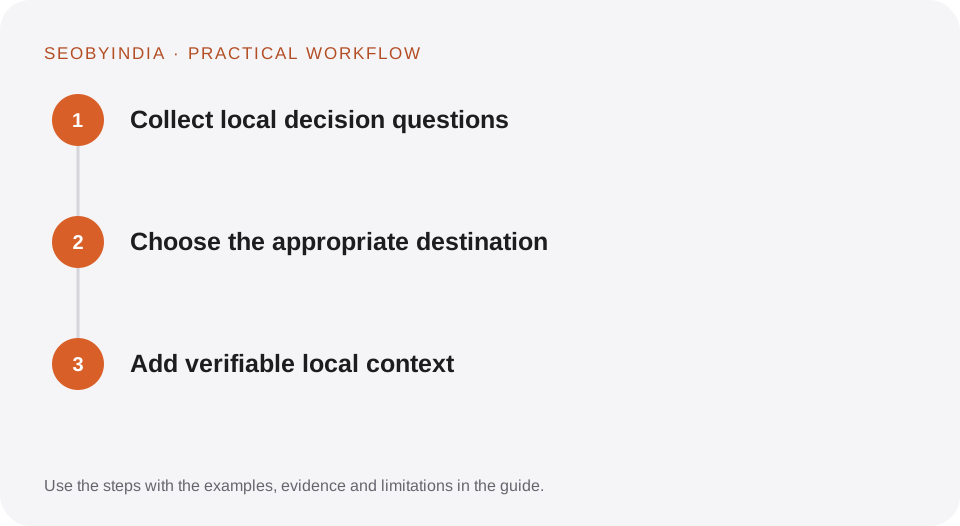
Collect local decision questions
Record actual questions about coverage, preparation, appointments and service limitations. Keep customer identities out of the public content plan.
Choose the appropriate destination
Improve a service page for recurring buying questions. Create a guide when the educational task is substantial and distinct. Avoid several articles competing to explain the same basic issue.
Add verifiable local context
Use real coverage and practical market terminology. Cite primary local requirements when relevant and arrange appropriate specialist review for regulated or safety-sensitive advice.
Illustrative scenario
What this looks like in practice
A painting business publishes a preparation checklist explaining what customers should clear before an assessment. The page links to the relevant service and uses the business’s actual process.
This is a worked example, not a claim about a client campaign or a promised result.
Before you sign it off
Do not invent local regulations or property conditions. Do not present generic national advice as verified guidance for a particular municipality.
Keep a useful decision record
- Purpose
- Write the customer task this change is meant to improve.
- Evidence
- Save the relevant page, source or observation and its date.
- Owner
- Identify who implements the change and who verifies it.
- Acceptance
- State what a correct result looks like before measuring its wider effect.
What to measure
Track useful customer feedback, suitable local enquiries and repeated questions reduced by clearer information.
Record the baseline and the observation window. If the measurement setup changes, annotate the report before comparing periods. Use the findings to choose the next useful improvement, rather than treating one encouraging result as proof of a permanent outcome.
Sources and further reading
These primary references provide platform guidance and context. The workflows and scenarios on this page are editorial explanations; a source link does not turn an example into a measured result.
Need help applying this?
Start with your website, target audience and the problem you want to solve. We can agree on the useful work, implementation responsibilities and reporting.
Explore the relevant serviceDiscuss the scope