
Understand the decision
Local businesses need enough detail to decide which services and areas are bringing worthwhile demand without collecting unnecessary personal data.
Agree what counts as a qualified enquiry and an accepted job. Note unavailable areas and unsuitable work types so raw lead totals are not mistaken for quality.
A practical workflow
Work through the sequence below. Keep the evidence, the change you make and the acceptance check together so the next person can understand the decision.
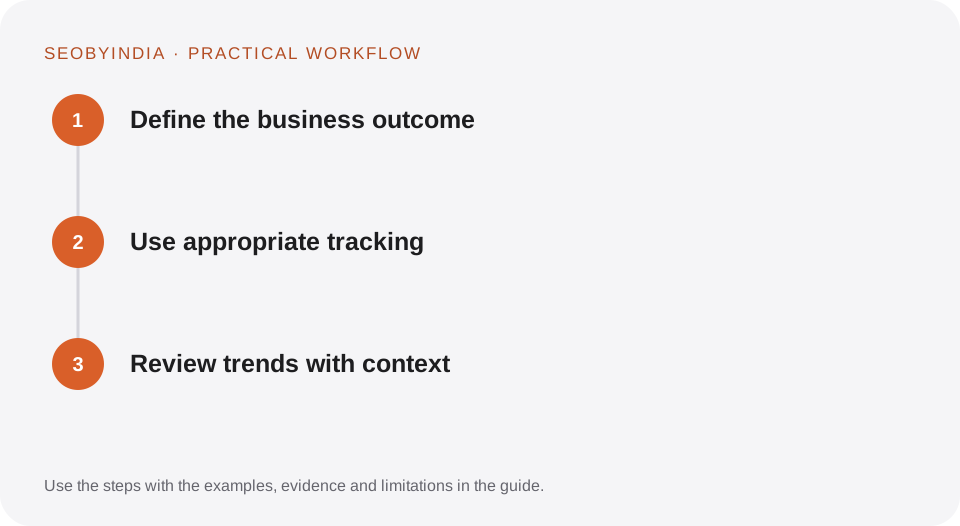
Define the business outcome
Agree what counts as a qualified enquiry and an accepted job. Note unavailable areas and unsuitable work types so raw lead totals are not mistaken for quality.
Use appropriate tracking
Review available business-profile actions, website events and enquiry records. Test tracking on mobile and avoid counting a form page view as a successful submission.
Review trends with context
Compare equivalent periods and consider seasonality, capacity and operational changes. Record uncertain attribution rather than assigning every enquiry to the last visible click.
Illustrative scenario
What this looks like in practice
A contractor sees more form submissions but many are outside its service area. The next action is clearer coverage information and qualification, not simply celebrating the increased total.
This is a worked example, not a claim about a client campaign or a promised result.
Before you sign it off
Do not equate a map-pack screenshot at one location with universal local visibility. Results can vary by searcher context.
Keep a useful decision record
- Purpose
- Write the customer task this change is meant to improve.
- Evidence
- Save the relevant page, source or observation and its date.
- Owner
- Identify who implements the change and who verifies it.
- Acceptance
- State what a correct result looks like before measuring its wider effect.
What to measure
Track qualified enquiries by service and area, accepted work and reliable tracking coverage with clear reporting limitations.
Record the baseline and the observation window. If the measurement setup changes, annotate the report before comparing periods. Use the findings to choose the next useful improvement, rather than treating one encouraging result as proof of a permanent outcome.
Sources and further reading
These primary references provide platform guidance and context. The workflows and scenarios on this page are editorial explanations; a source link does not turn an example into a measured result.
Need help applying this?
Start with your website, target audience and the problem you want to solve. We can agree on the useful work, implementation responsibilities and reporting.
Explore the relevant serviceDiscuss the scope