
Understand the decision
Customers often need to decide quickly whether a provider can help with their specific problem. A generic page listing every possible plumbing service can obscure that decision.
Separate repair, installation, maintenance and any genuine emergency work. Use customer language while preserving accurate scope. Identify work the business does not accept.
A practical workflow
Work through the sequence below. Keep the evidence, the change you make and the acceptance check together so the next person can understand the decision.
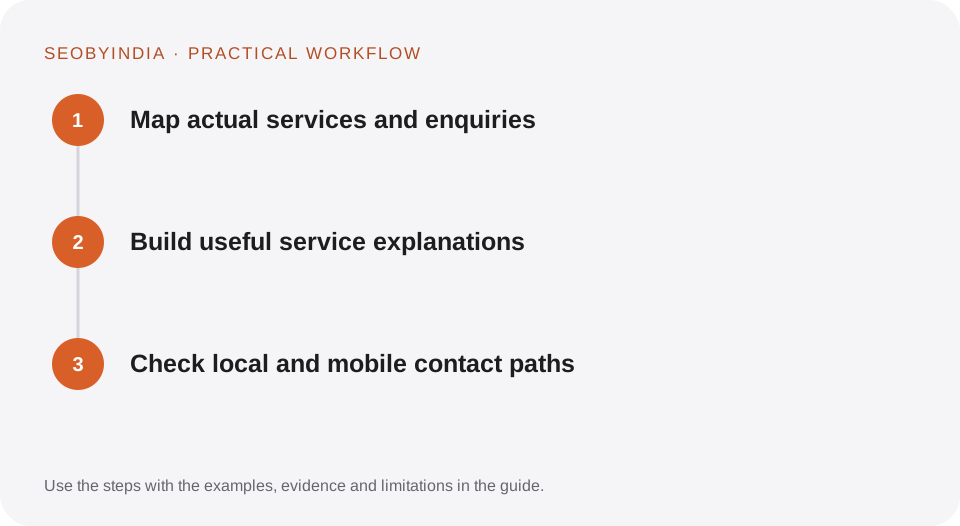
Map actual services and enquiries
Separate repair, installation, maintenance and any genuine emergency work. Use customer language while preserving accurate scope. Identify work the business does not accept.
Build useful service explanations
Describe symptoms, what information helps triage an enquiry and what the service process involves. Avoid giving unsafe repair instructions or implying a remote diagnosis is certain.
Check local and mobile contact paths
Use real service areas and consistent public details. Make phone links and forms easy to use. Record whether enquiries are for jobs the business can fulfil.
Illustrative scenario
What this looks like in practice
A residential plumber’s tap-repair page explains accepted work and asks for the location and problem description. It does not invent a fixed callout price or a 24-hour promise.
This is a worked example, not a claim about a client campaign or a promised result.
Before you sign it off
Do not reuse identical pages for every suburb. Do not imply a licence, guarantee or emergency response that the business has not confirmed.
Keep a useful decision record
- Purpose
- Write the customer task this change is meant to improve.
- Evidence
- Save the relevant page, source or observation and its date.
- Owner
- Identify who implements the change and who verifies it.
- Acceptance
- State what a correct result looks like before measuring its wider effect.
What to measure
Measure suitable plumbing enquiries, accepted jobs and the accuracy of search queries reaching each service page.
Record the baseline and the observation window. If the measurement setup changes, annotate the report before comparing periods. Use the findings to choose the next useful improvement, rather than treating one encouraging result as proof of a permanent outcome.
Sources and further reading
These primary references provide platform guidance and context. The workflows and scenarios on this page are editorial explanations; a source link does not turn an example into a measured result.
Need help applying this?
Start with your website, target audience and the problem you want to solve. We can agree on the useful work, implementation responsibilities and reporting.
Explore the relevant serviceDiscuss the scope