
Understand the decision
Responses should address the experience professionally without exposing private customer information. A public reply is not the place to reproduce an entire dispute.
Ask eligible real customers consistently. Explain that honest feedback is welcome. Follow current platform rules about incentives and solicitation.
A practical workflow
Work through the sequence below. Keep the evidence, the change you make and the acceptance check together so the next person can understand the decision.
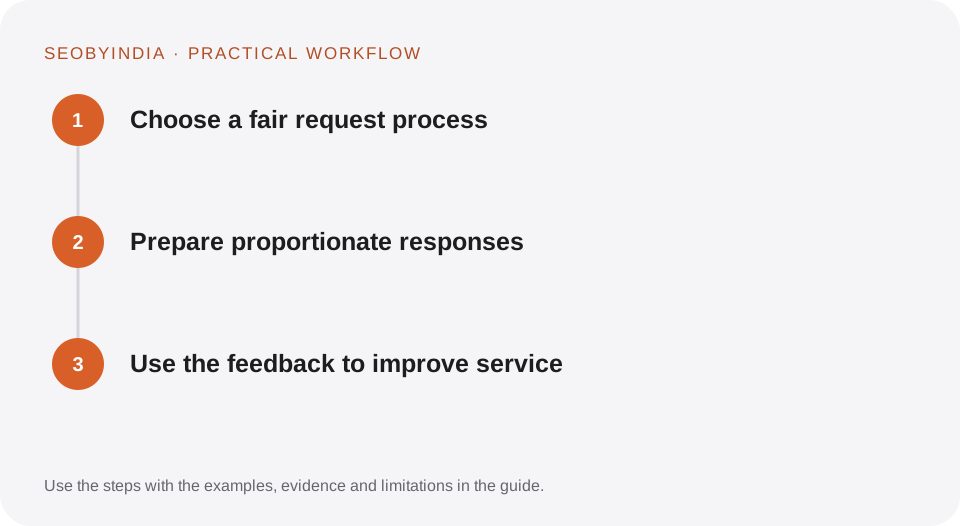
Choose a fair request process
Ask eligible real customers consistently. Explain that honest feedback is welcome. Follow current platform rules about incentives and solicitation.
Prepare proportionate responses
Thank customers for useful feedback and address concerns calmly. Move sensitive details to an appropriate private support route. Do not imply that a reviewer must remove criticism to receive help.
Use the feedback to improve service
Group recurring themes and assign real operational actions. Record corrections and do not measure success only by the average star rating.
Illustrative scenario
What this looks like in practice
A customer reports unclear appointment communication. The public response acknowledges the concern without disclosing their address, while the business improves its confirmation process.
This is a worked example, not a claim about a client campaign or a promised result.
Before you sign it off
Avoid review gating, purchased reviews and fabricated customer quotations. Do not publish a testimonial without the appropriate basis and permission.
Keep a useful decision record
- Purpose
- Write the customer task this change is meant to improve.
- Evidence
- Save the relevant page, source or observation and its date.
- Owner
- Identify who implements the change and who verifies it.
- Acceptance
- State what a correct result looks like before measuring its wider effect.
What to measure
Track genuine feedback themes, response quality, resolution patterns and actual service improvements.
Record the baseline and the observation window. If the measurement setup changes, annotate the report before comparing periods. Use the findings to choose the next useful improvement, rather than treating one encouraging result as proof of a permanent outcome.
Sources and further reading
These primary references provide platform guidance and context. The workflows and scenarios on this page are editorial explanations; a source link does not turn an example into a measured result.
Need help applying this?
Start with your website, target audience and the problem you want to solve. We can agree on the useful work, implementation responsibilities and reporting.
Explore the relevant serviceDiscuss the scope