
Understand the decision
A contractor’s website can attract unsuitable leads when every service is described too broadly. Explain boundaries and the information needed to assess a job.
Record the work accepted, coverage and any confirmed qualifications. Separate refurbishment, new installation and maintenance when their buying questions differ.
A practical workflow
Work through the sequence below. Keep the evidence, the change you make and the acceptance check together so the next person can understand the decision.
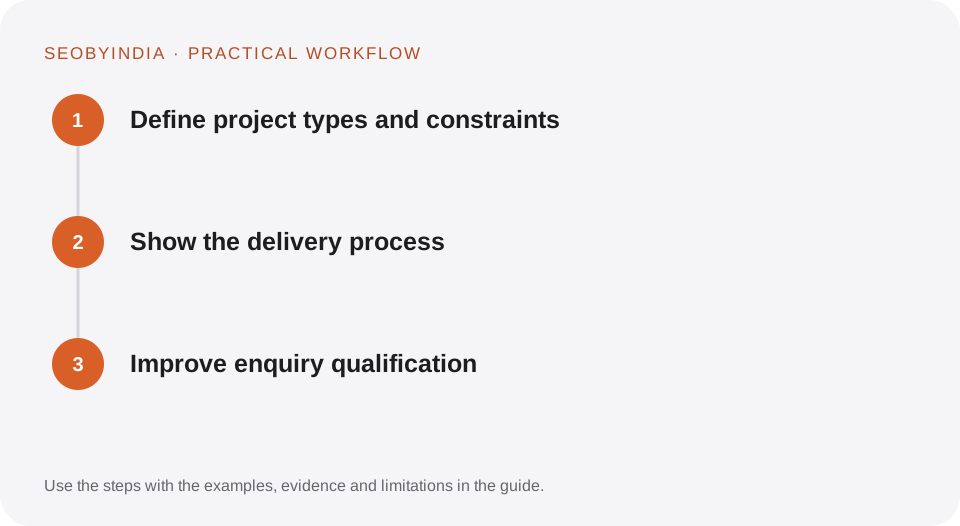
Define project types and constraints
Record the work accepted, coverage and any confirmed qualifications. Separate refurbishment, new installation and maintenance when their buying questions differ.
Show the delivery process
Explain site assessment, scope agreement, materials decisions and communication points. Use real authorised project examples or clearly labelled illustrations.
Improve enquiry qualification
Ask for practical project information without demanding unnecessary personal records. Route visitors to the right service and explain how a quotation is developed.
Illustrative scenario
What this looks like in practice
A renovation page explains what an initial project discussion covers and which decisions require a site visit. It avoids presenting an illustrative budget as a universal price.
This is a worked example, not a claim about a client campaign or a promised result.
Before you sign it off
Do not publish other people’s project photos as your portfolio. Do not invent certifications, insurance cover or guaranteed completion dates.
Keep a useful decision record
- Purpose
- Write the customer task this change is meant to improve.
- Evidence
- Save the relevant page, source or observation and its date.
- Owner
- Identify who implements the change and who verifies it.
- Acceptance
- State what a correct result looks like before measuring its wider effect.
What to measure
Track project-fit enquiries, proposal quality and recurring questions that the page should answer more clearly.
Record the baseline and the observation window. If the measurement setup changes, annotate the report before comparing periods. Use the findings to choose the next useful improvement, rather than treating one encouraging result as proof of a permanent outcome.
Sources and further reading
These primary references provide platform guidance and context. The workflows and scenarios on this page are editorial explanations; a source link does not turn an example into a measured result.
Need help applying this?
Start with your website, target audience and the problem you want to solve. We can agree on the useful work, implementation responsibilities and reporting.
Explore the relevant serviceDiscuss the scope