
The short answer
Check that language-region references point to the intended accessible equivalents and are implemented consistently.
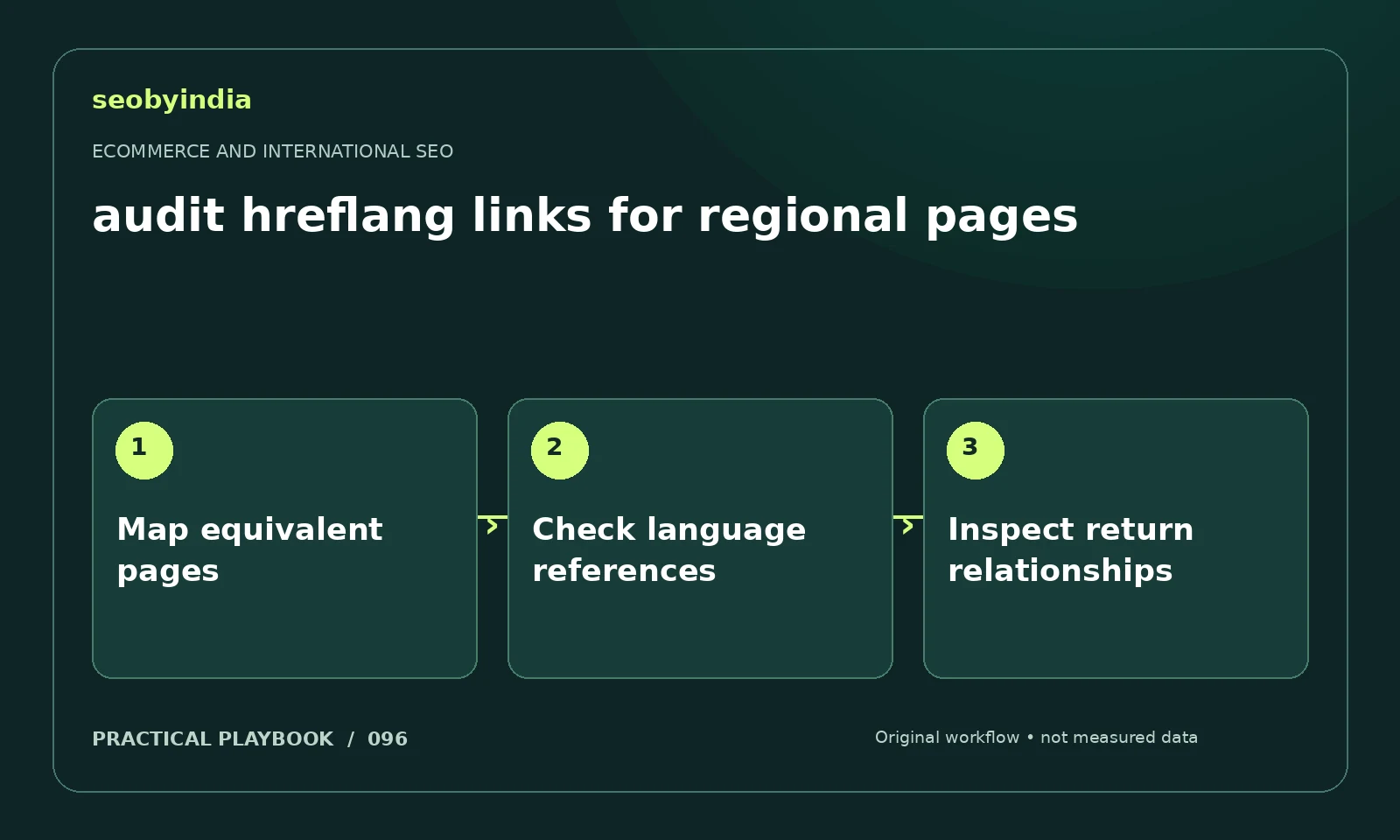
A three-step workflow
Map equivalent pages
Map true language or regional equivalents before generating annotations. A page with no equivalent should not point to an unrelated substitute.
Check language references
Check language and optional region codes, referenced URLs and accessibility. Avoid treating a country code as a complete language annotation.
Inspect return relationships
Review consistency across the referenced set, including reciprocal relationships where required. Validate at template scale after correction.
Illustrative example
Put the decision in context
An English UK service page should reference the relevant alternate version rather than an unrelated regional homepage.
What to record in your working sheet
Keep the evidence beside the decision so the work can be checked and handed over. For this task, use these fields:
- Product, regional or legacy URL
- Inventory or audience requirement
- Preferred destination and technical signals
- Implementation owner and verification result
A mistake to avoid
Using country codes alone where a language code is required.
References and further reading
The workflow and illustrative example are SEOByIndia editorial guidance. Use the linked primary documentation for platform requirements; interfaces and policies can change.
Need help applying this to your site?
Share your website, the problem you are investigating and the evidence you already have. We can discuss a focused scope and the next useful check.
Discuss your ecommerce or migration audit