
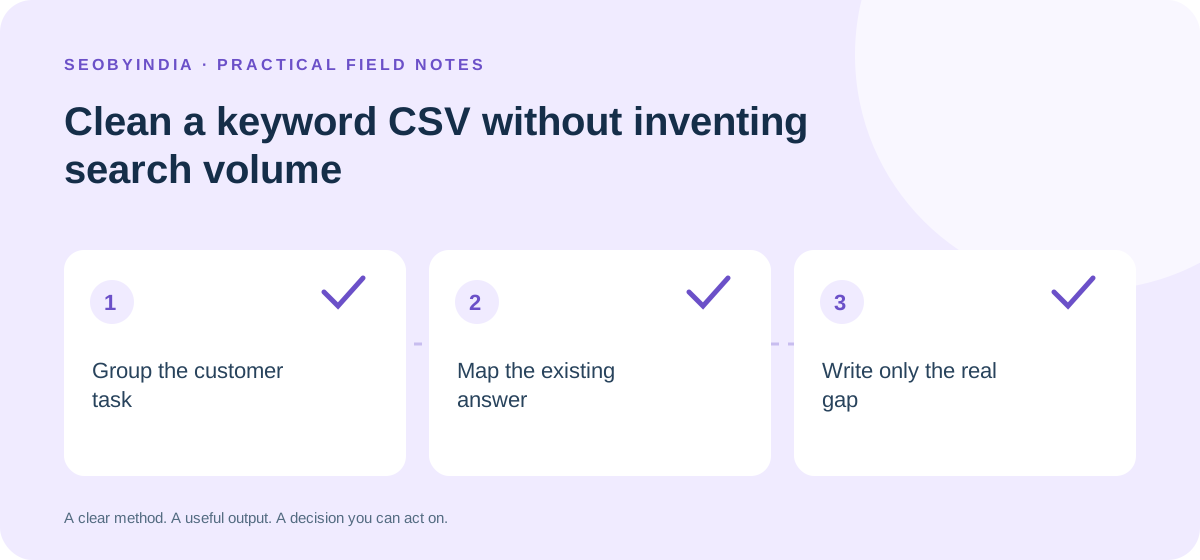
A list of phrases is not yet a content strategy. Several phrases may describe the same customer task, while one short phrase can have several meanings. For a small website, begin by deciding what each customer needs to accomplish and whether an existing page already provides the answer.
Clean the list without losing its meaning
Paste one phrase per line into the free keyword organiser. Remove exact duplicates and review the suggested groups. The organiser uses visible wording rules: phrases containing pricing may suggest a commercial task, while how-to wording often suggests a learning task. These are starting points, not a prediction of the actual search results.
Imagine a local service business with these phrases: roof repair cost, emergency roof leak repair, roof maintenance checklist and roofer near me. A price question, an urgent booking and a maintenance lesson are different tasks. They may need different sections or pages, depending on the offer and the depth of the answer. Avoid making four near-identical pages simply because four phrases exist.
Map each task to the page that should answer it
- Existing answer: record the current URL and the customer question it serves.
- Missing detail: note the example, qualification, service information or next step the page lacks.
- Distinct gap: identify tasks that cannot be answered clearly on an existing page without changing that page’s purpose.
- Priority: consider business relevance, customer urgency and the evidence available to write a credible answer.
Inspect results before deciding on format
Review the actual results for important phrases in the intended market. Note whether people are shown service providers, comparison resources, definitions or practical guides. Record the date and market used. This manual check helps correct a rule-based intent guess, but it still does not supply a reliable search-volume or difficulty estimate.
If you need volume or competitive data, obtain it from an appropriate data source and keep its date and methodology with the decision. Do not label a number as measured traffic or search demand when it is only a guess. A useful page can start from a real customer question even when volume data is unavailable.
Export a worksheet with one job
Download the organiser’s CSV and add columns for the current URL, the missing detail and the next action. Keep an untouched copy of the supplied list so edits are traceable. Give the writer the task, intended audience, existing pages to reference, facts they can use and the action the reader should be able to take. Include one concrete example and a way to check the answer. Link the new resource to the relevant service or next step.
For an existing answer, a small improvement may be enough. Add the missing explanation rather than creating another page with the same purpose. The content strategy process should leave the website easier to understand and maintain, not just larger.