
Structured data is easiest to maintain when it describes facts already visible to a customer. Start with the business’s actual name, appropriate page URL, contact information and any public location details. A schema generator helps with syntax; it does not verify that the business details are true or guarantee a search feature.
Use the public page as the source of truth
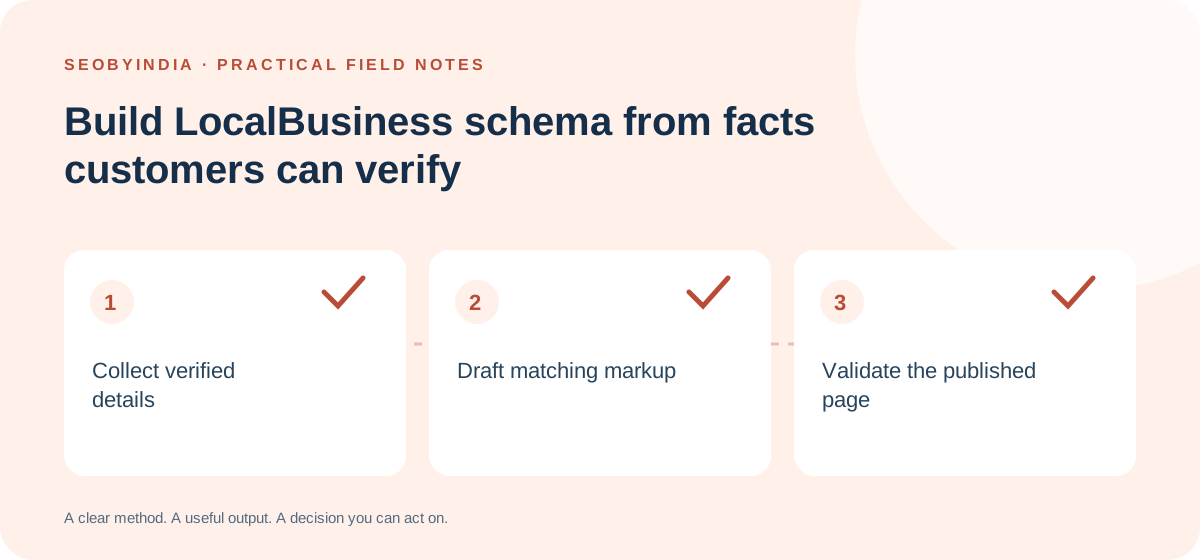
Make a short worksheet containing the business name, location page, telephone number, public address when applicable, opening hours and image URL. Check the same facts on the visible page. If the business operates by appointment or has a service area, resolve how it describes that arrangement before copying details into markup.
For example, a plumbing business should not invent an office address in every town it serves. Its service pages can explain the genuine coverage area and how bookings work. Markup should reinforce that information. The result is a coherent description of one business rather than a collection of fictional branches.
Draft the smallest accurate version
- Open the free schema builder and choose the relevant type.
- Enter the name and canonical page URL exactly as the business uses them.
- Add only the contact and location fields you can verify.
- Read the generated JSON, then compare it with the visible page before publishing.
The basic builder produces a starting point. More specific business types and feature-specific properties may need additional editing. Use the current documentation for the search feature you intend to support rather than assuming every schema.org property is required everywhere.
Keep ratings honest
Do not create review counts, average ratings or testimonials to make the output look more complete. Google’s local business guidance describes review properties for particular contexts, and its review policy excludes self-serving review snippets for businesses and organisations reviewing themselves. Adding a review widget does not create an entitlement to stars in search.
Validate the page, then maintain the facts
Check JSON syntax and the relevant search-engine validator after implementation. Test the published URL as well as the draft. A valid JSON document may still lack properties needed for a particular feature, and eligibility does not guarantee that the feature will appear.
When hours, telephone details or locations change, update the visible page and the markup together. Record who owns the business information and how often it is checked. This is a useful maintenance task for local SEO, because the customer needs dependable contact information regardless of how a search engine presents the result.