
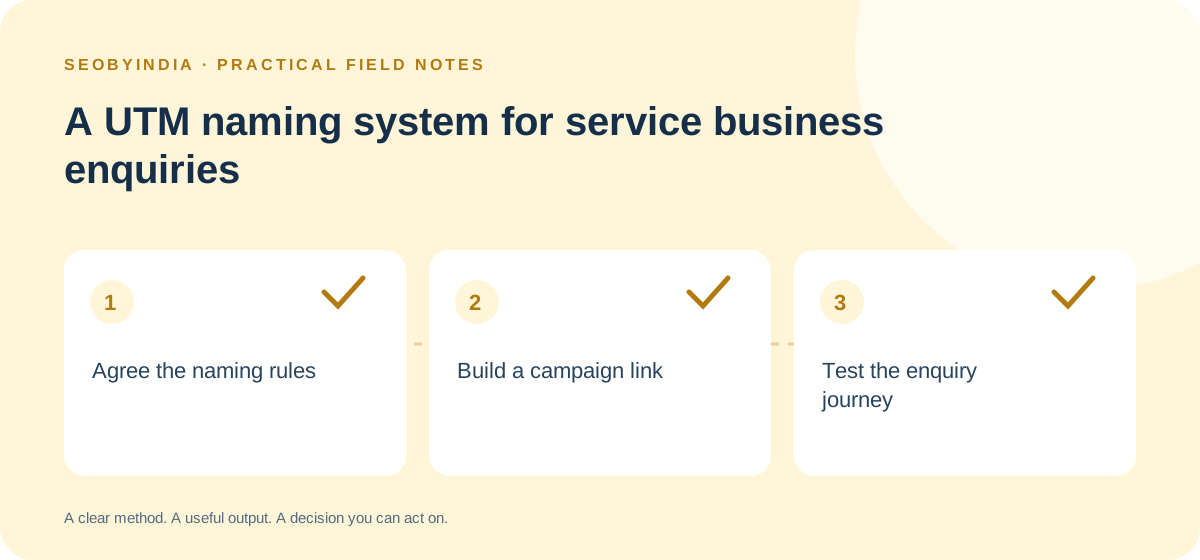
Campaign links become difficult to compare when one person uses Email, another writes newsletter and a third invents a new campaign name for every link. A small naming dictionary is often more useful than a complicated spreadsheet. Start with labels your team can apply consistently and connect them to a real enquiry journey.
Define the three essential labels
Use source for where the visit originates, medium for the channel and campaign for the initiative. The labels should describe the activity, not the identity of an individual customer. For a practical example, an agency’s monthly resource email might use source=client_newsletter, medium=email and campaign=2026_11_audit_guide.
| Parameter | Example value | Team rule |
|---|---|---|
| utm_source | client_newsletter | Use the same publication or platform label each time. |
| utm_medium | Use an agreed channel dictionary. | |
| utm_campaign | 2026_11_audit_guide | Give the initiative one stable name. |
| utm_content | footer_button | Use only when comparing placements or creative variants. |
Build one link and test it end to end
Use the free campaign URL builder to construct the link. Paste the destination before adding parameters, and check that existing parameters remain intact. Open the generated result, confirm that it reaches the expected page and verify that the visible offer matches the message that sent the customer there.
On a site you own, test the analytics configuration and the enquiry event with an identifiable test submission. A UTM label alone does not prove that analytics is installed correctly or that a form completion has been recorded. If your report cannot connect the visit to the action, document the missing measurement step rather than reporting an invented conversion.
Keep internal navigation separate
Reserve campaign labels for the acquisition activity you intend to measure. Adding new campaign tags to routine internal navigation can make the journey harder to interpret. For experiments within your own site, agree a suitable event or experiment measurement method with the person who maintains analytics.
Review naming before scaling
Keep the dictionary to a handful of approved medium values and a predictable campaign pattern. Record who owns the link and when the campaign ends. Avoid email addresses, names, phone numbers or other personal details in URL parameters: URLs may appear in logs, history and reports.
After launch, inspect the actual source and medium rows in your reporting tool. Correct inconsistent tagging in the next campaign and annotate any historical naming changes. Analytics and conversion work should make business decisions clearer, starting with data that has a known origin and a tested collection path.