
Understand the decision
A paragraph written solely to resemble a snippet can oversimplify a complex decision. Put the necessary conditions beside the answer and avoid implying certainty where the answer depends on context.
Answer the page’s central question in plain language. Include the most important condition. A yes-or-no question may need a qualified answer rather than an absolute slogan.
A practical workflow
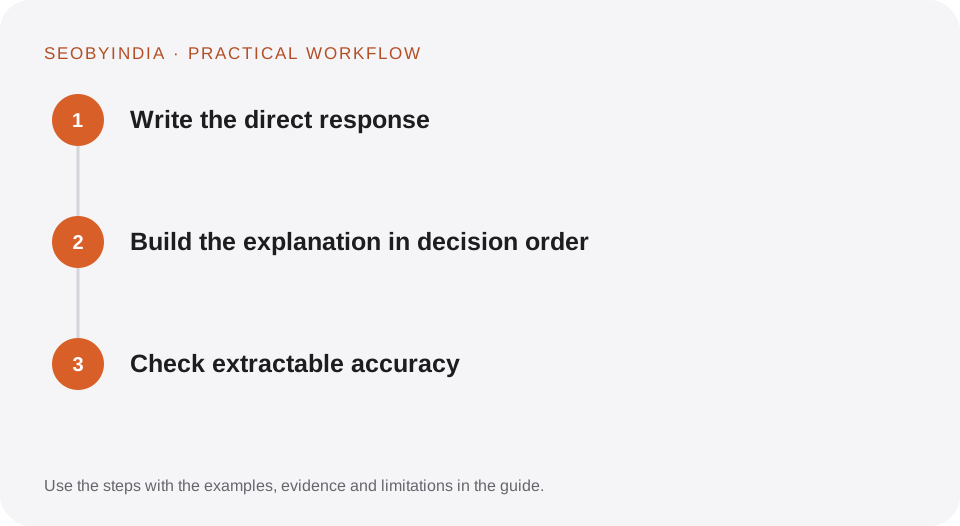
Work through the sequence below. Keep the evidence, the change you make and the acceptance check together so the next person can understand the decision.
Write the direct response
Answer the page’s central question in plain language. Include the most important condition. A yes-or-no question may need a qualified answer rather than an absolute slogan.
Build the explanation in decision order
Follow the answer with the evidence, process, examples and limitations. Use headings that describe real questions. Keep a reader from needing several unrelated pages to complete a basic task.
Check extractable accuracy
Read the opening paragraph on its own. If it would mislead without a distant disclaimer, revise it. Keep tables and visual captions understandable in their own context.
Illustrative scenario
What this looks like in practice
For whether a sitemap guarantees indexing, the opening says no and explains its discovery role. The page then shows what belongs in the sitemap, how to validate destinations and what to review in webmaster tools.
This is a worked example, not a claim about a client campaign or a promised result.
Before you sign it off
Do not hide crucial exceptions after a long sales section. Avoid artificial paragraph fragmentation intended only to influence a model.
Keep a useful decision record
- Purpose
- Write the customer task this change is meant to improve.
- Evidence
- Save the relevant page, source or observation and its date.
- Owner
- Identify who implements the change and who verifies it.
- Acceptance
- State what a correct result looks like before measuring its wider effect.
What to measure
Assess whether readers can identify the answer and complete the next step. Search performance is additional evidence, not the definition of clarity.
Record the baseline and the observation window. If the measurement setup changes, annotate the report before comparing periods. Use the findings to choose the next useful improvement, rather than treating one encouraging result as proof of a permanent outcome.
Sources and further reading
These primary references provide platform guidance and context. The workflows and scenarios on this page are editorial explanations; a source link does not turn an example into a measured result.
Need help applying this?
Start with your website, target audience and the problem you want to solve. We can agree on the useful work, implementation responsibilities and reporting.
Explore the relevant serviceDiscuss the scope