
Understand the decision
Do not treat a response produced without live search as proof of current website visibility. Separate knowledge recalled by a model from sources fetched during a search-enabled task.
Identify Claude-SearchBot separately from other Anthropic user agents. Preserve private routes and existing training preferences. Review the official documentation when configuring the current site response.
A practical workflow
Work through the sequence below. Keep the evidence, the change you make and the acceptance check together so the next person can understand the decision.
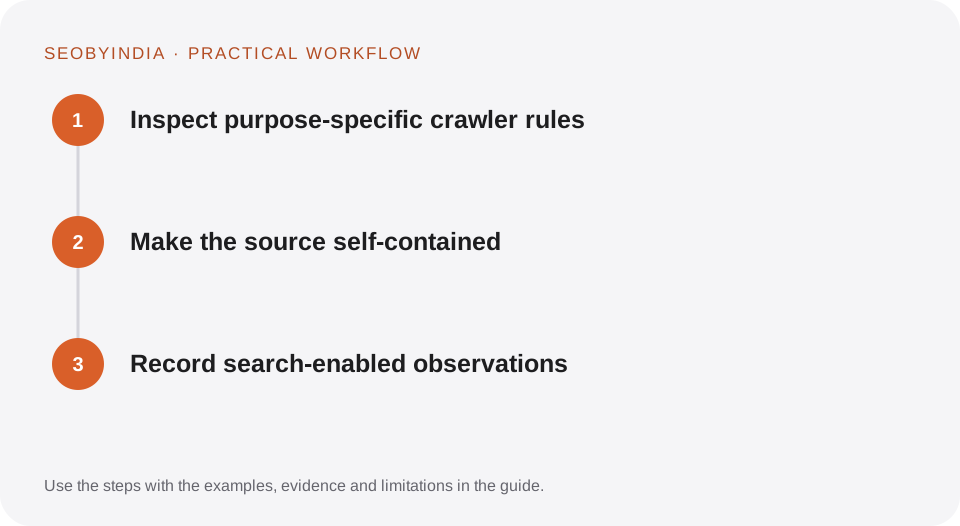
Inspect purpose-specific crawler rules
Identify Claude-SearchBot separately from other Anthropic user agents. Preserve private routes and existing training preferences. Review the official documentation when configuring the current site response.
Make the source self-contained
Use a descriptive title, a direct explanation, meaningful headings and supported business information. Explain limitations where they affect a decision. Link the page to its topic hub and related evidence.
Record search-enabled observations
Use realistic questions and retain the cited URL, date, query and visible search context. Compare the type of answer and source choice, not just whether the brand name appears anywhere.
Illustrative scenario
What this looks like in practice
A guide explains how to assess editorial backlink opportunities and includes a clear due-diligence table. A search-enabled answer may cite that guide for the evaluation process. That observation is different from a recommendation to hire the business.
This is a worked example, not a claim about a client campaign or a promised result.
Before you sign it off
Do not claim that adding a hidden instruction to the page will force Claude to recommend a provider. Publish useful information for people and keep promotional claims supported.
Keep a useful decision record
- Purpose
- Write the customer task this change is meant to improve.
- Evidence
- Save the relevant page, source or observation and its date.
- Owner
- Identify who implements the change and who verifies it.
- Acceptance
- State what a correct result looks like before measuring its wider effect.
What to measure
Review citation URLs, consistency of business descriptions and identifiable referral actions. Note missing or uncertain attribution in analytics.
Record the baseline and the observation window. If the measurement setup changes, annotate the report before comparing periods. Use the findings to choose the next useful improvement, rather than treating one encouraging result as proof of a permanent outcome.
Sources and further reading
These primary references provide platform guidance and context. The workflows and scenarios on this page are editorial explanations; a source link does not turn an example into a measured result.
Need help applying this?
Start with your website, target audience and the problem you want to solve. We can agree on the useful work, implementation responsibilities and reporting.
Explore the relevant serviceDiscuss the scope