
Understand the decision
A new acronym does not remove the need for accessible pages, accurate information and credible expertise. The meaningful difference is the question being measured: a search listing, an answer citation, a brand mention or a qualified customer action.
Specify Google Search, AI Overviews, ChatGPT search or Claude search rather than treating every AI product as one channel. Document whether live web search is enabled in the observation.
A practical workflow
Work through the sequence below. Keep the evidence, the change you make and the acceptance check together so the next person can understand the decision.
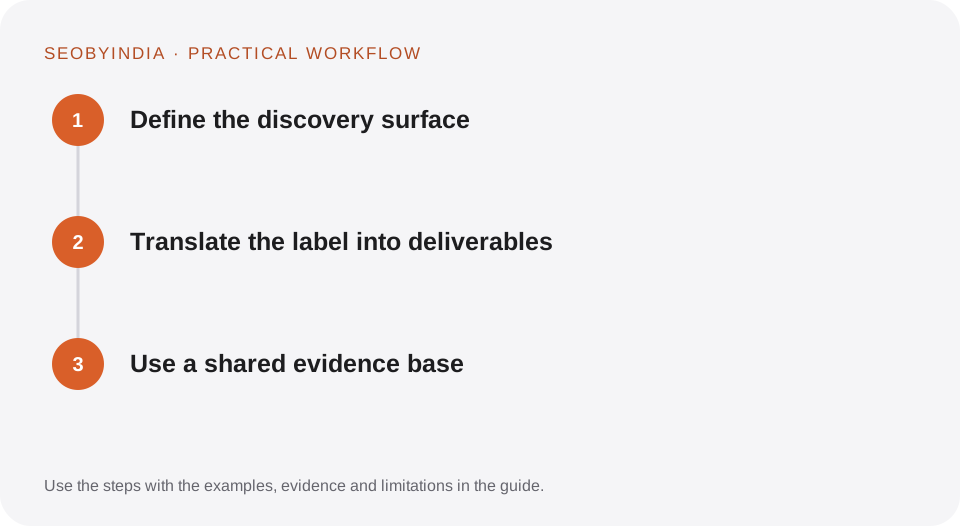
Define the discovery surface
Specify Google Search, AI Overviews, ChatGPT search or Claude search rather than treating every AI product as one channel. Document whether live web search is enabled in the observation.
Translate the label into deliverables
List crawl checks, content improvements, source development and monitoring. Ask which changes are on the website and which require outside editorial work. Keep model-training access separate from search access.
Use a shared evidence base
Maintain accurate business facts, useful service information and strong educational pages. Connect them with relevant links. Record observed mentions and citations without presenting one result as a stable universal ranking.
Illustrative scenario
What this looks like in practice
A business requests GEO. The agreed work becomes a public-page access check, correction of inconsistent service details, a guide that answers common buying questions and a repeated observation set across named search-enabled tools. The report distinguishes mentions from linked citations.
This is a worked example, not a claim about a client campaign or a promised result.
Before you sign it off
Do not sell special schema, an AI text file or keyword stuffing as a guaranteed admission mechanism. Google’s published guidance says its ordinary SEO foundations remain relevant to its AI search features.
Keep a useful decision record
- Purpose
- Write the customer task this change is meant to improve.
- Evidence
- Save the relevant page, source or observation and its date.
- Owner
- Identify who implements the change and who verifies it.
- Acceptance
- State what a correct result looks like before measuring its wider effect.
What to measure
Measure indexed pages and relevant search visits alongside observed mentions, citation URLs and qualified enquiries. Keep each denominator and observation date.
Record the baseline and the observation window. If the measurement setup changes, annotate the report before comparing periods. Use the findings to choose the next useful improvement, rather than treating one encouraging result as proof of a permanent outcome.
Sources and further reading
These primary references provide platform guidance and context. The workflows and scenarios on this page are editorial explanations; a source link does not turn an example into a measured result.
Need help applying this?
Start with your website, target audience and the problem you want to solve. We can agree on the useful work, implementation responsibilities and reporting.
Explore the relevant serviceDiscuss the scope