
Understand the decision
Without a fixed method, changing prompts can make a brand look more visible without improving its real discoverability. Keep baseline questions and exploratory questions in separate groups.
Include learning, comparison and service-selection tasks from genuine customer needs. Avoid loading the set with the brand name when measuring discovery by people who do not already know it.
A practical workflow
Work through the sequence below. Keep the evidence, the change you make and the acceptance check together so the next person can understand the decision.
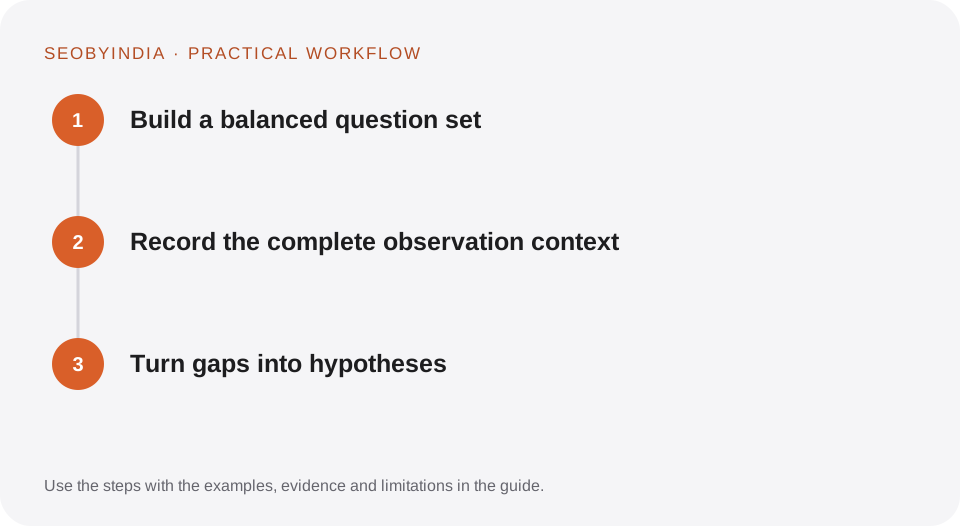
Build a balanced question set
Include learning, comparison and service-selection tasks from genuine customer needs. Avoid loading the set with the brand name when measuring discovery by people who do not already know it.
Record the complete observation context
Capture the date, product, search availability, question and linked source destinations. Distinguish a citation, a brand mention and an unrelated name match.
Turn gaps into hypotheses
Compare cited source quality, missing explanations and inconsistent business facts. Recommend specific page improvements. Repeat the original sample later and state its limitations.
Illustrative scenario
What this looks like in practice
A 20-question sample produces eight answers with linked sources and three with a link to the business. Report both the source-bearing subset and the whole sample. Do not silently change the denominator to inflate a percentage.
This is a worked example, not a claim about a client campaign or a promised result.
Before you sign it off
Do not present sampled visibility as market share or assume every user receives the same answer. Avoid collecting private customer prompts without a clear purpose and permission.
Keep a useful decision record
- Purpose
- Write the customer task this change is meant to improve.
- Evidence
- Save the relevant page, source or observation and its date.
- Owner
- Identify who implements the change and who verifies it.
- Acceptance
- State what a correct result looks like before measuring its wider effect.
What to measure
Track query coverage, linked citations, brand mentions, landing-page accuracy and repeatability across scheduled observations.
Record the baseline and the observation window. If the measurement setup changes, annotate the report before comparing periods. Use the findings to choose the next useful improvement, rather than treating one encouraging result as proof of a permanent outcome.
Sources and further reading
These primary references provide platform guidance and context. The workflows and scenarios on this page are editorial explanations; a source link does not turn an example into a measured result.
Need help applying this?
Start with your website, target audience and the problem you want to solve. We can agree on the useful work, implementation responsibilities and reporting.
Explore the relevant serviceDiscuss the scope