
Understand the decision
AI features do not appear for every query, and the cited sources can vary. Improve the information and technical foundations because they help readers and search broadly, not only one presentation format.
Check that the page is public, indexable as intended and able to show a snippet. Inspect rendered content, canonical signals and relevant internal links. Resolve confirmed technical blockers before changing copy repeatedly.
A practical workflow
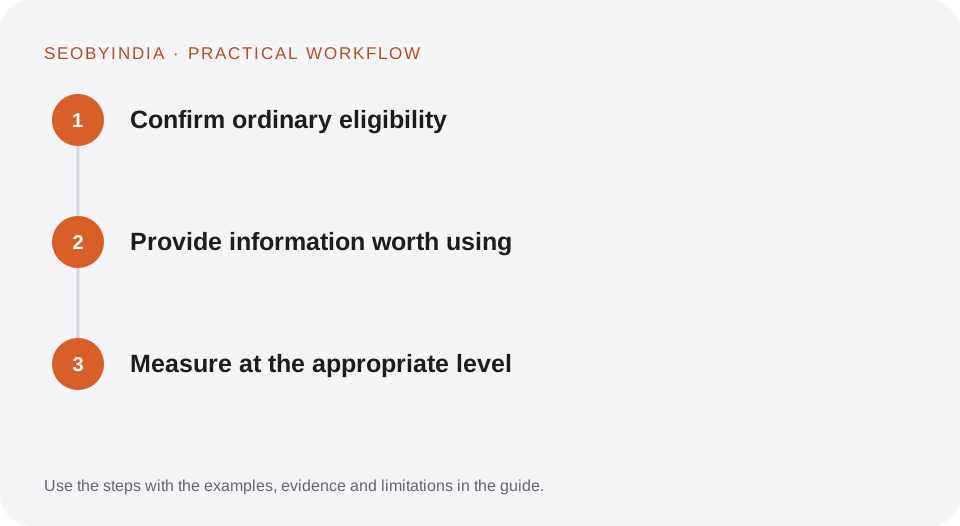
Work through the sequence below. Keep the evidence, the change you make and the acceptance check together so the next person can understand the decision.
Confirm ordinary eligibility
Check that the page is public, indexable as intended and able to show a snippet. Inspect rendered content, canonical signals and relevant internal links. Resolve confirmed technical blockers before changing copy repeatedly.
Provide information worth using
Explain the topic with original examples, clear conditions and appropriate sources. Add media when it improves understanding. Keep structured data consistent with visible facts.
Measure at the appropriate level
Record manual observations carefully and use available webmaster data with its actual reporting scope. Do not label all organic search traffic as AI Overview traffic when the data does not separate it.
Illustrative scenario
What this looks like in practice
A technical guide answers a specific migration question, includes an explicit decision table and explains exceptions. Its value is the complete answer and implementation detail; it does not contain special text instructing an AI to cite the site.
This is a worked example, not a claim about a client campaign or a promised result.
Before you sign it off
Do not promise an AI Overview placement for every target keyword. Eligibility, indexing, feature availability and source selection remain separate matters.
Keep a useful decision record
- Purpose
- Write the customer task this change is meant to improve.
- Evidence
- Save the relevant page, source or observation and its date.
- Owner
- Identify who implements the change and who verifies it.
- Acceptance
- State what a correct result looks like before measuring its wider effect.
What to measure
Use relevant impressions, clicks and qualified outcomes, plus dated observations of the AI feature where it is actually present.
Record the baseline and the observation window. If the measurement setup changes, annotate the report before comparing periods. Use the findings to choose the next useful improvement, rather than treating one encouraging result as proof of a permanent outcome.
Sources and further reading
These primary references provide platform guidance and context. The workflows and scenarios on this page are editorial explanations; a source link does not turn an example into a measured result.
Need help applying this?
Start with your website, target audience and the problem you want to solve. We can agree on the useful work, implementation responsibilities and reporting.
Explore the relevant serviceDiscuss the scope