
Understand the decision
Precise-looking numbers can hide uncertain inputs. Use ranges and keep third-party estimates separate from first-party baselines.
Record the current pages, relevant traffic and useful actions using the best available data. Label estimates and missing information. Avoid treating every keyword volume as an additional unique visitor.
A practical workflow
Work through the sequence below. Keep the evidence, the change you make and the acceptance check together so the next person can understand the decision.
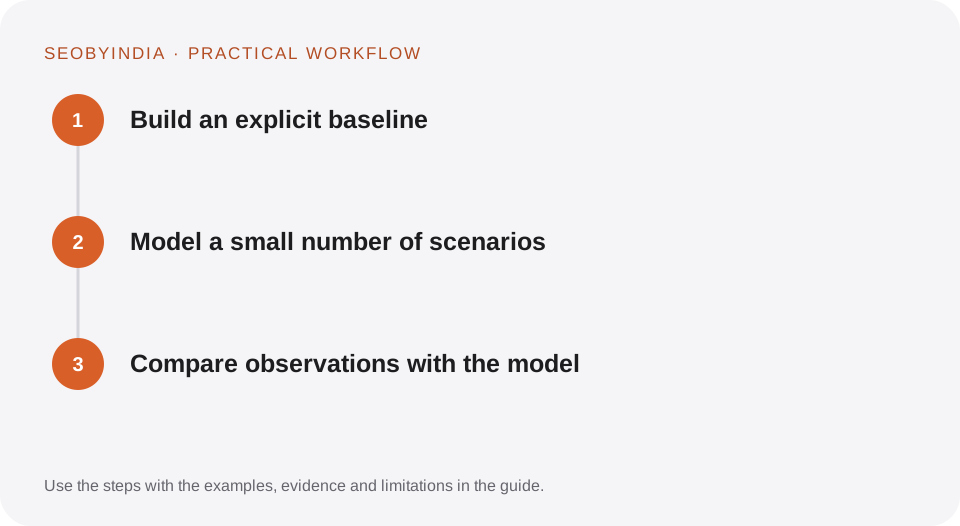
Build an explicit baseline
Record the current pages, relevant traffic and useful actions using the best available data. Label estimates and missing information. Avoid treating every keyword volume as an additional unique visitor.
Model a small number of scenarios
Vary plausible inputs such as relevant impressions, click rate and qualification rate. Show the calculation and the implementation assumptions for each scenario.
Compare observations with the model
Update assumptions when real evidence changes. Explain where the scenario was wrong. Keep delivery commitments separate from outcome forecasts.
Illustrative scenario
What this looks like in practice
A planning model uses 2,000 relevant visits, an illustrative 2% enquiry rate and a 40% qualification rate to produce 16 qualified enquiries. The page labels those inputs as a scenario and allows the visitor to change them.
This is a worked example, not a claim about a client campaign or a promised result.
Before you sign it off
Do not add the search volumes of close keyword variants and call the total a guaranteed audience. Do not quote a single forecast without its assumptions.
Keep a useful decision record
- Purpose
- Write the customer task this change is meant to improve.
- Evidence
- Save the relevant page, source or observation and its date.
- Owner
- Identify who implements the change and who verifies it.
- Acceptance
- State what a correct result looks like before measuring its wider effect.
What to measure
Track forecast error, assumption changes and actual qualified actions over comparable windows.
Record the baseline and the observation window. If the measurement setup changes, annotate the report before comparing periods. Use the findings to choose the next useful improvement, rather than treating one encouraging result as proof of a permanent outcome.
Sources and further reading
These primary references provide platform guidance and context. The workflows and scenarios on this page are editorial explanations; a source link does not turn an example into a measured result.
Need help applying this?
Start with your website, target audience and the problem you want to solve. We can agree on the useful work, implementation responsibilities and reporting.
Explore the relevant serviceDiscuss the scope