
Understand the decision
A reader can get a complete answer and leave. That is not automatically a failed visit. Combine behaviour with evidence about usefulness and business relevance.
State the audience question, intended next step and evidence needed to judge success. Keep this beside the content brief or register.
A practical workflow
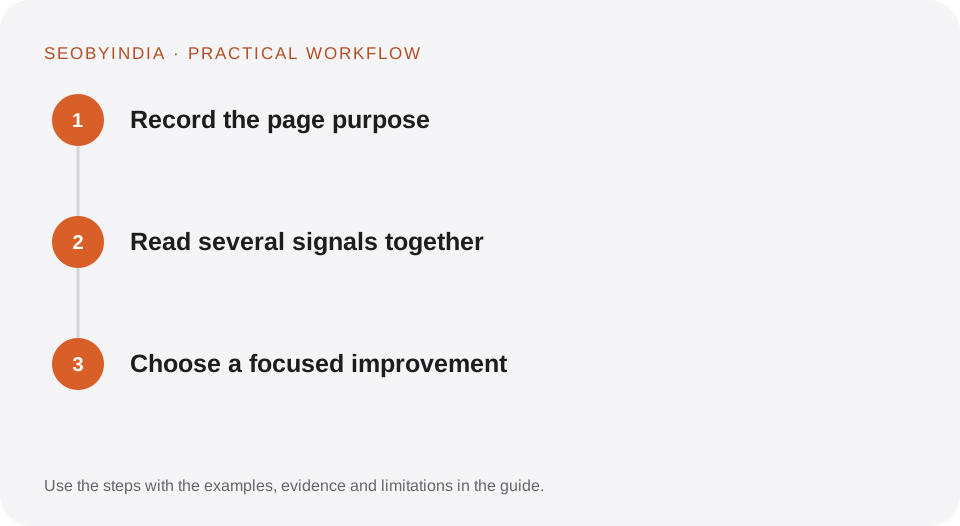
Work through the sequence below. Keep the evidence, the change you make and the acceptance check together so the next person can understand the decision.
Record the page purpose
State the audience question, intended next step and evidence needed to judge success. Keep this beside the content brief or register.
Read several signals together
Review relevant search queries, suitable traffic, useful navigation and completed actions. Separate education, discovery and buying decisions rather than assigning the same target to all pages.
Choose a focused improvement
Fix missing answers, confusing structure or a weak next step based on the evidence. Consolidate overlap when appropriate and document material changes.
Illustrative scenario
What this looks like in practice
A robots.txt guide succeeds when it helps readers understand crawler controls accurately. Some may then use the checklist or request technical support, but the guide should not withhold its explanation to force that action.
This is a worked example, not a claim about a client campaign or a promised result.
Before you sign it off
Do not use dwell time as a universal quality score. Do not add unnecessary content solely to keep a visitor on the page longer.
Keep a useful decision record
- Purpose
- Write the customer task this change is meant to improve.
- Evidence
- Save the relevant page, source or observation and its date.
- Owner
- Identify who implements the change and who verifies it.
- Acceptance
- State what a correct result looks like before measuring its wider effect.
What to measure
Track task-relevant queries, resource use, useful onward actions and reader feedback within the available data.
Record the baseline and the observation window. If the measurement setup changes, annotate the report before comparing periods. Use the findings to choose the next useful improvement, rather than treating one encouraging result as proof of a permanent outcome.
Sources and further reading
These primary references provide platform guidance and context. The workflows and scenarios on this page are editorial explanations; a source link does not turn an example into a measured result.
Need help applying this?
Start with your website, target audience and the problem you want to solve. We can agree on the useful work, implementation responsibilities and reporting.
Explore the relevant serviceDiscuss the scope