
Understand the decision
A numerical score can help a team discuss priorities, but it does not remove judgement. Make assumptions visible and do not let false precision hide uncertainty.
Explain which pages, customers or business actions the issue influences. Distinguish a confirmed blocker from a possible improvement.
A practical workflow
Work through the sequence below. Keep the evidence, the change you make and the acceptance check together so the next person can understand the decision.
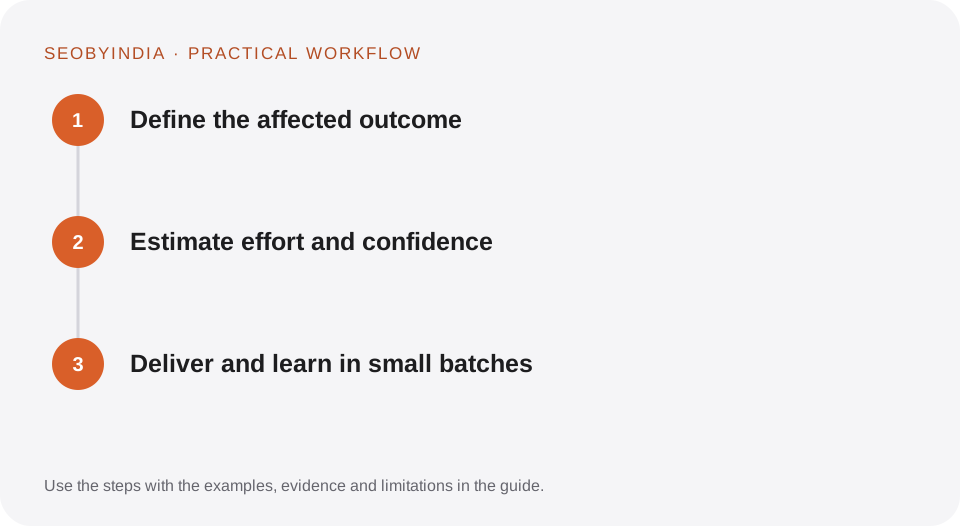
Define the affected outcome
Explain which pages, customers or business actions the issue influences. Distinguish a confirmed blocker from a possible improvement.
Estimate effort and confidence
Include review, development, content and verification work. Note dependencies and whether the expected benefit is supported by evidence or only a hypothesis.
Deliver and learn in small batches
Assign an owner, acceptance check and review point. Reprioritise when new evidence changes the opportunity. Keep a record of deferred decisions.
Illustrative scenario
What this looks like in practice
A broken enquiry form is fixed before a decorative animation is added. A shared canonical error on core services is prioritised before a small metadata experiment on a low-value archive.
This is a worked example, not a claim about a client campaign or a promised result.
Before you sign it off
Do not equate a tool’s issue count with business impact. Avoid promising a precise traffic gain from an untested task score.
Keep a useful decision record
- Purpose
- Write the customer task this change is meant to improve.
- Evidence
- Save the relevant page, source or observation and its date.
- Owner
- Identify who implements the change and who verifies it.
- Acceptance
- State what a correct result looks like before measuring its wider effect.
What to measure
Track time to resolve important blockers, accepted changes, verification quality and observed business impact.
Record the baseline and the observation window. If the measurement setup changes, annotate the report before comparing periods. Use the findings to choose the next useful improvement, rather than treating one encouraging result as proof of a permanent outcome.
Sources and further reading
These primary references provide platform guidance and context. The workflows and scenarios on this page are editorial explanations; a source link does not turn an example into a measured result.
Need help applying this?
Start with your website, target audience and the problem you want to solve. We can agree on the useful work, implementation responsibilities and reporting.
Explore the relevant serviceDiscuss the scope