
Understand the decision
A report can contain many charts and still leave the client unsure what happened. Use a consistent baseline and explain the limits of each source.
Agree on target audiences, important services and what counts as a useful result. Select a few measures that answer those questions rather than adding every available metric.
A practical workflow
Work through the sequence below. Keep the evidence, the change you make and the acceptance check together so the next person can understand the decision.
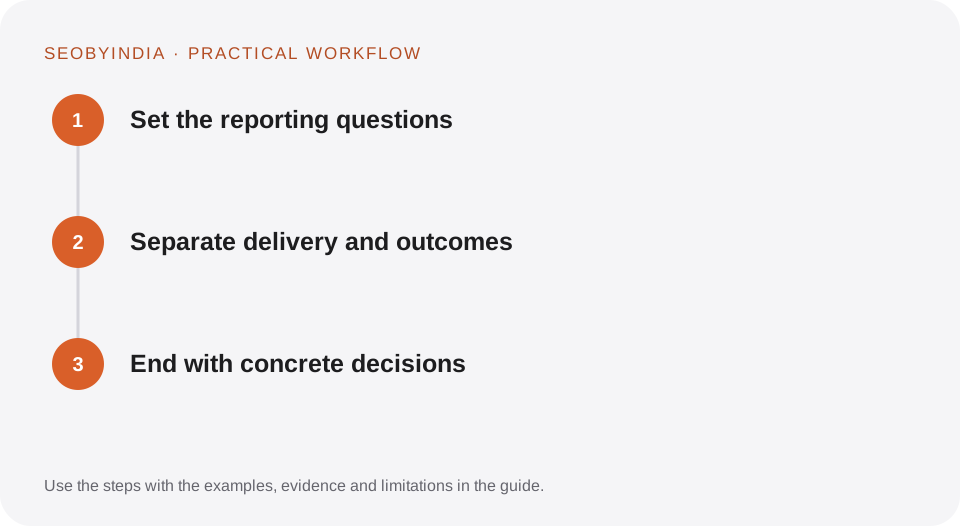
Set the reporting questions
Agree on target audiences, important services and what counts as a useful result. Select a few measures that answer those questions rather than adding every available metric.
Separate delivery and outcomes
List material fixes, pages and outreach work with evidence. Report impressions, clicks and suitable enquiries separately. Explain whether a change is observed, estimated or still too early to assess.
End with concrete decisions
State the next priority, why it matters and what will be checked. Record blockers and implementation responsibilities. Keep the comparison window consistent.
Illustrative scenario
What this looks like in practice
A monthly report shows that a service template was corrected, relevant impressions increased and enquiries are still flat. The next action investigates the enquiry journey instead of claiming the technical fix has already produced revenue.
This is a worked example, not a claim about a client campaign or a promised result.
Before you sign it off
Do not present third-party traffic estimates as exact analytics data. Do not hide a tracking change inside an unexplained percentage increase.
Keep a useful decision record
- Purpose
- Write the customer task this change is meant to improve.
- Evidence
- Save the relevant page, source or observation and its date.
- Owner
- Identify who implements the change and who verifies it.
- Acceptance
- State what a correct result looks like before measuring its wider effect.
What to measure
Track relevant search visibility, qualified actions and agreed work completed, with dates, sources and denominators.
Record the baseline and the observation window. If the measurement setup changes, annotate the report before comparing periods. Use the findings to choose the next useful improvement, rather than treating one encouraging result as proof of a permanent outcome.
Sources and further reading
These primary references provide platform guidance and context. The workflows and scenarios on this page are editorial explanations; a source link does not turn an example into a measured result.
Need help applying this?
Start with your website, target audience and the problem you want to solve. We can agree on the useful work, implementation responsibilities and reporting.
Explore the relevant serviceDiscuss the scope