
Understand the decision
A newly published article can be technically available but difficult to discover. The right fix is often a link from an existing hub or related guide, not another isolated page or a large unrelated footer list.
Identify the foundation, the specific task and the next decision. A technical audit guide should connect to crawlability and measurement, while a service page should explain when specialist implementation is appropriate.
A practical workflow
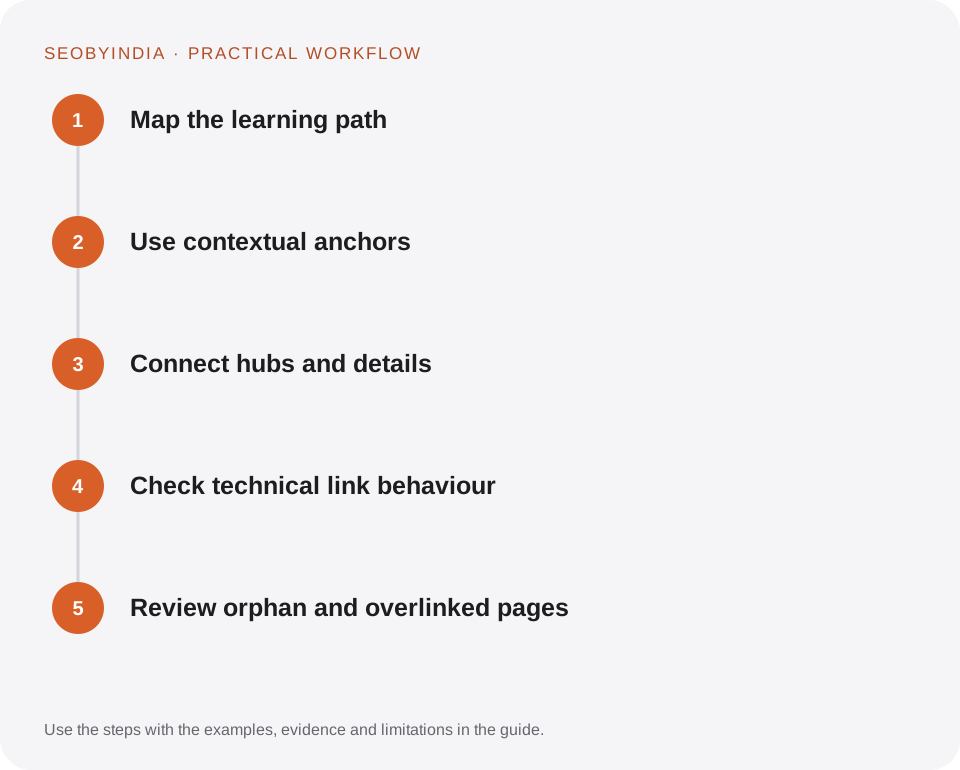
Work through the sequence below. Keep the evidence, the change you make and the acceptance check together so the next person can understand the decision.
Map the learning path
Identify the foundation, the specific task and the next decision. A technical audit guide should connect to crawlability and measurement, while a service page should explain when specialist implementation is appropriate.
Use contextual anchors
Describe the destination in natural language. Put the link where the reader needs the extra detail. Avoid vague click here anchors when the surrounding sentence does not clarify the purpose.
Connect hubs and details
Link from each topic hub to its guides and from each guide back to the hub. Add a small set of genuinely related next steps rather than every page in the site.
Check technical link behaviour
Use ordinary crawlable anchors with real destinations. Retain useful links when JavaScript is unavailable. Repair broken links and excessive redirect chains.
Review orphan and overlinked pages
Find important pages with no meaningful incoming links. Review pages with crowded repetitive link blocks. The goal is clarity, not the largest possible number of links.
Illustrative scenario
What this looks like in practice
A beginner reading the canonical guide can follow a link to redirects when deciding whether a retired page should remain accessible. The anchor describes that decision and the destination provides the needed distinction.
This is a worked example, not a claim about a client campaign or a promised result.
Before you sign it off
Do not add unrelated commercial links to every sentence. Internal links should support the current task and the destination should fulfil the promise of its anchor.
Keep a useful decision record
- Purpose
- Write the customer task this change is meant to improve.
- Evidence
- Save the relevant page, source or observation and its date.
- Owner
- Identify who implements the change and who verifies it.
- Acceptance
- State what a correct result looks like before measuring its wider effect.
What to measure
Track important orphan URLs, broken internal destinations and use of relevant next-step links. Do not assume more clicks always mean a better answer.
Record the baseline and the observation window. If the measurement setup changes, annotate the report before comparing periods. Use the findings to choose the next useful improvement, rather than treating one encouraging result as proof of a permanent outcome.
Sources and further reading
These primary references provide platform guidance and context. The workflows and scenarios on this page are editorial explanations; a source link does not turn an example into a measured result.
Need help applying this?
Start with your website, target audience and the problem you want to solve. We can agree on the useful work, implementation responsibilities and reporting.
Explore the relevant serviceDiscuss the scope