
Understand the decision
A long article can still be incomplete when it delays the answer, hides limitations or never explains what to do next. Start with the question, give the main response and develop the details in a logical order.
Write one sentence describing the audience, question and outcome. Check that the page actually delivers it. Avoid promising a complete guide when the content only introduces the topic.
A practical workflow
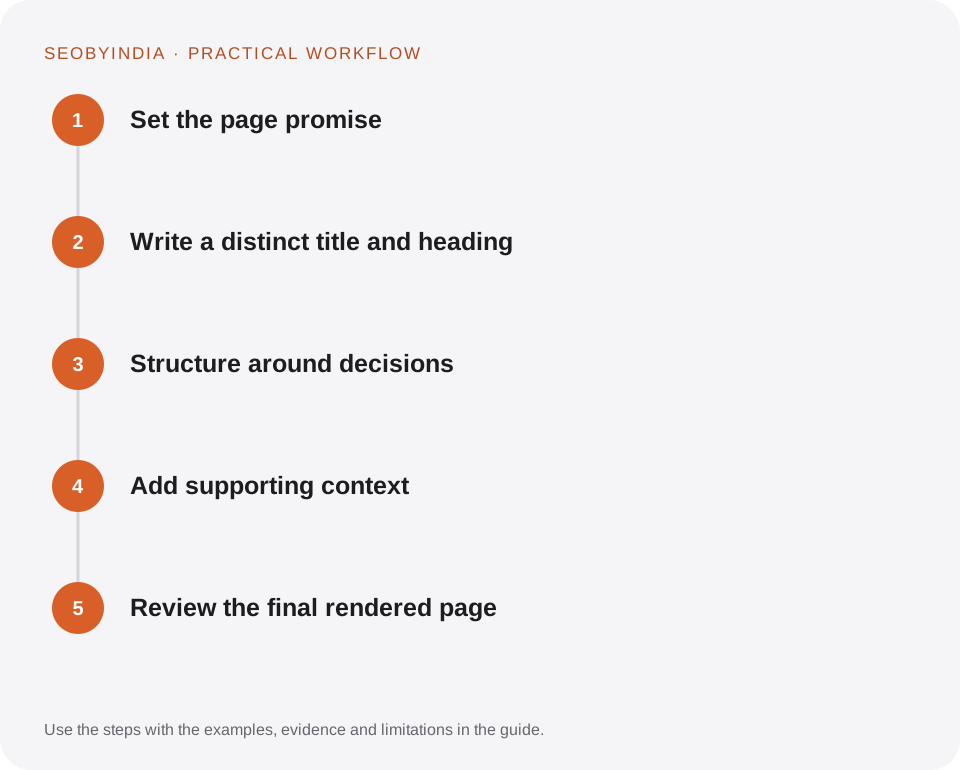
Work through the sequence below. Keep the evidence, the change you make and the acceptance check together so the next person can understand the decision.
Set the page promise
Write one sentence describing the audience, question and outcome. Check that the page actually delivers it. Avoid promising a complete guide when the content only introduces the topic.
Write a distinct title and heading
Use an accurate title that differentiates the page from neighbouring resources. Make the main heading clear without stuffing several near-identical keywords into it.
Structure around decisions
Use meaningful section headings, examples and tables where they clarify a choice. Put caveats next to the claims they qualify rather than burying them in the footer.
Add supporting context
Link to primary sources for platform-specific requirements. Explain who prepared the material and distinguish real evidence from an illustrative example. Keep images relevant and describe them accessibly.
Review the final rendered page
Check mobile reading, title output, canonical, links and the action path. Edit for missing information and repetition. A plugin score cannot establish accuracy or expertise.
Illustrative scenario
What this looks like in practice
A service page answers who the service suits, what work is included, what inputs are needed, what remains the client’s responsibility and how progress will be reported. Supporting guides explain the methods in more detail.
This is a worked example, not a claim about a client campaign or a promised result.
Before you sign it off
Avoid repeating a keyword to reach a density target. There is no universal density that turns an unhelpful page into a useful result.
Keep a useful decision record
- Purpose
- Write the customer task this change is meant to improve.
- Evidence
- Save the relevant page, source or observation and its date.
- Owner
- Identify who implements the change and who verifies it.
- Acceptance
- State what a correct result looks like before measuring its wider effect.
What to measure
Review query relevance, task completion and qualified actions for the page. Separate content quality checks from traffic outcomes.
Record the baseline and the observation window. If the measurement setup changes, annotate the report before comparing periods. Use the findings to choose the next useful improvement, rather than treating one encouraging result as proof of a permanent outcome.
Sources and further reading
These primary references provide platform guidance and context. The workflows and scenarios on this page are editorial explanations; a source link does not turn an example into a measured result.
Need help applying this?
Start with your website, target audience and the problem you want to solve. We can agree on the useful work, implementation responsibilities and reporting.
Explore the relevant serviceDiscuss the scope