
Understand the decision
An India-based specialist can work with clients abroad without claiming local offices. Explain communication, scope, market terminology and implementation responsibilities honestly before deciding whether separate regional pages are needed.
Document language, currency, service coverage, customer questions and sales process. Distinguish countries served from places where the business has a physical presence.
A practical workflow
Work through the sequence below. Keep the evidence, the change you make and the acceptance check together so the next person can understand the decision.
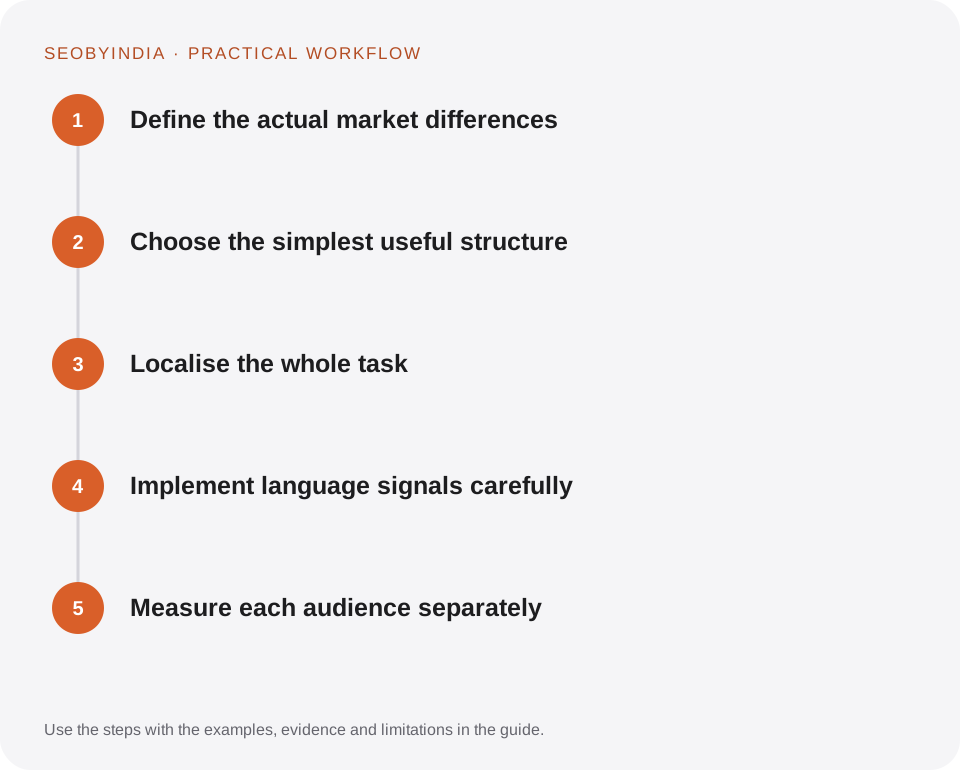
Define the actual market differences
Document language, currency, service coverage, customer questions and sales process. Distinguish countries served from places where the business has a physical presence.
Choose the simplest useful structure
Use a shared page when the offer and information are substantially the same. Consider dedicated market content when it provides meaningfully different guidance or service details.
Localise the whole task
Adapt terminology, examples, units, opening-hour context and enquiry expectations. Do not change spelling while leaving an incompatible offer or unavailable service.
Implement language signals carefully
For genuine equivalent language or regional versions, review canonical and hreflang requirements using primary documentation. Keep reciprocal relationships and actual language content consistent.
Measure each audience separately
Compare qualified visits and enquiries by market. Note when country data is uncertain. Use customer conversations to identify missing buying information.
Illustrative scenario
What this looks like in practice
A New Zealand campaign brief uses local terminology and actual service areas, while the shared agency page explains cross-time-zone communication. The business does not fabricate an Auckland office or a separate page for every suburb.
This is a worked example, not a claim about a client campaign or a promised result.
Before you sign it off
Avoid near-identical country pages that all funnel to the same offer without adding local value. Establish the useful difference first.
Keep a useful decision record
- Purpose
- Write the customer task this change is meant to improve.
- Evidence
- Save the relevant page, source or observation and its date.
- Owner
- Identify who implements the change and who verifies it.
- Acceptance
- State what a correct result looks like before measuring its wider effect.
What to measure
Monitor relevant market queries, qualified enquiries and the accuracy of regional landing-page selection.
Record the baseline and the observation window. If the measurement setup changes, annotate the report before comparing periods. Use the findings to choose the next useful improvement, rather than treating one encouraging result as proof of a permanent outcome.
Sources and further reading
These primary references provide platform guidance and context. The workflows and scenarios on this page are editorial explanations; a source link does not turn an example into a measured result.
Need help applying this?
Start with your website, target audience and the problem you want to solve. We can agree on the useful work, implementation responsibilities and reporting.
Explore the relevant serviceDiscuss the scope