
Understand the decision
Tools often flag the same issue across hundreds of URLs. The important question is whether it affects a business-critical template, a deliberately excluded page or a harmless variation. Group findings by root cause and impact before assigning work.
Collect sitemap URLs, internal links, key landing pages and recent Search Console information. Identify which page types should be public and indexable. Keep staging, account and search-result URLs outside that intended set.
A practical workflow
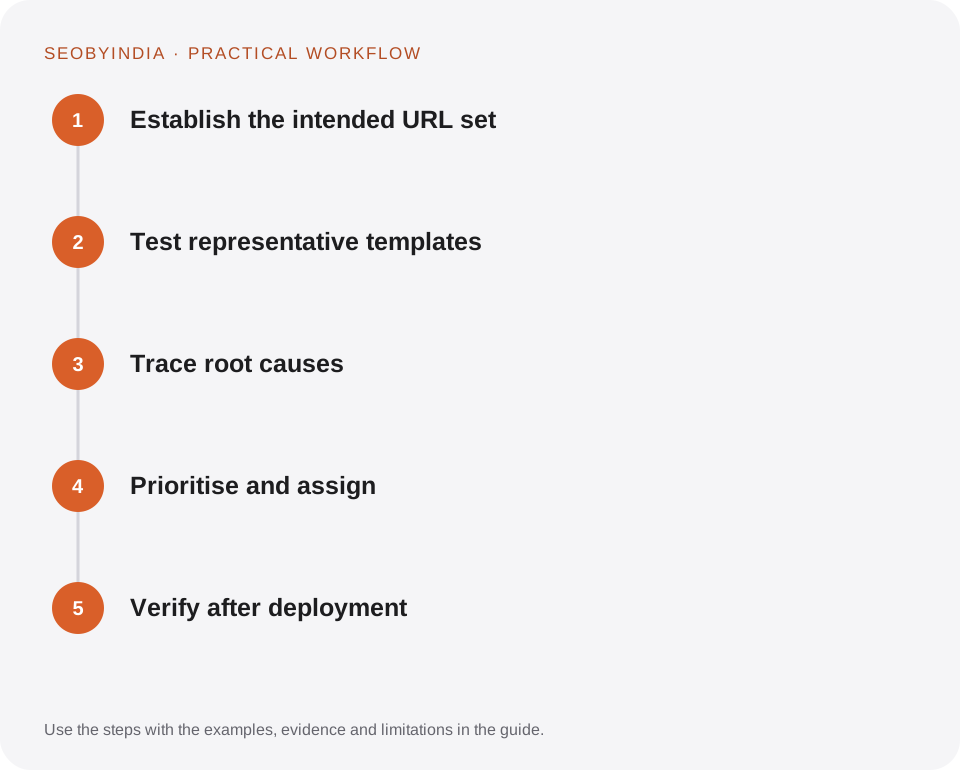
Work through the sequence below. Keep the evidence, the change you make and the acceptance check together so the next person can understand the decision.
Establish the intended URL set
Collect sitemap URLs, internal links, key landing pages and recent Search Console information. Identify which page types should be public and indexable. Keep staging, account and search-result URLs outside that intended set.
Test representative templates
Check service pages, articles, pagination and important media separately. Record status, canonical, robots directives, rendered content and internal links. A working homepage does not prove every template is healthy.
Trace root causes
Connect duplicate URLs to navigation, filters, redirects or canonical rules. Explain why the problem occurs. Fixing a shared template can resolve many URLs more reliably than editing them one at a time.
Prioritise and assign
State the affected pages, customer impact, search risk, recommended change and implementation owner. Distinguish a confirmed blocker from an improvement or an unverified hypothesis.
Verify after deployment
Retest changed URLs and linked destinations. Compare the rendered result, response and indexing signals. Record the release date and review Search Console later without assuming a successful code deployment guarantees indexing.
Illustrative scenario
What this looks like in practice
An audit finds that every service page points its canonical to the homepage. The fix belongs in one template. The acceptance check confirms each representative service now has its own canonical while intentional duplicates still consolidate correctly.
This is a worked example, not a claim about a client campaign or a promised result.
Before you sign it off
A tool score is not a ranking score. Do not spend the entire budget eliminating minor warnings while a critical page remains unavailable or missing its main content.
Keep a useful decision record
- Purpose
- Write the customer task this change is meant to improve.
- Evidence
- Save the relevant page, source or observation and its date.
- Owner
- Identify who implements the change and who verifies it.
- Acceptance
- State what a correct result looks like before measuring its wider effect.
What to measure
Track resolved critical findings, affected important URLs, successful rechecks and index coverage over time. Keep ranking changes separate from technical acceptance.
Record the baseline and the observation window. If the measurement setup changes, annotate the report before comparing periods. Use the findings to choose the next useful improvement, rather than treating one encouraging result as proof of a permanent outcome.
Sources and further reading
These primary references provide platform guidance and context. The workflows and scenarios on this page are editorial explanations; a source link does not turn an example into a measured result.
Need help applying this?
Start with your website, target audience and the problem you want to solve. We can agree on the useful work, implementation responsibilities and reporting.
Explore the relevant serviceDiscuss the scope