
Understand the decision
The strongest briefs specify what must be verified and what must not be claimed. This is especially useful when AI helps draft the material.
State the trigger for the visit and what the reader should understand or do afterwards. Define the primary page type and the boundary of the topic.
A practical workflow
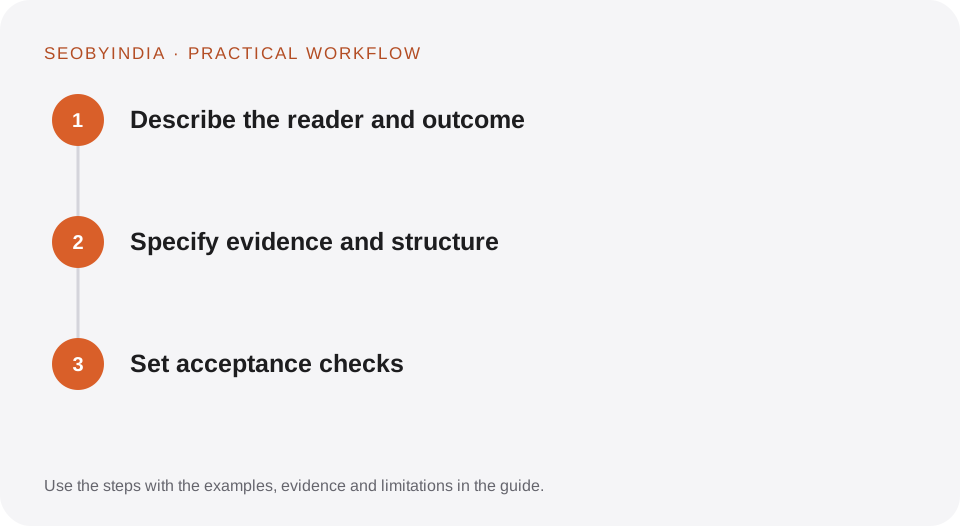
Work through the sequence below. Keep the evidence, the change you make and the acceptance check together so the next person can understand the decision.
Describe the reader and outcome
State the trigger for the visit and what the reader should understand or do afterwards. Define the primary page type and the boundary of the topic.
Specify evidence and structure
Provide approved facts, primary sources, examples to develop and questions to answer. Mark missing inputs clearly. Use headings as a starting structure rather than copying another site’s outline.
Set acceptance checks
Require accurate claims, readable mobile layout, descriptive links and a useful next action. Decide who reviews factual, technical and commercial details before publication.
Illustrative scenario
What this looks like in practice
A local-service brief includes the actual service area, hours and qualifications only when confirmed. Missing response times remain a question for the business rather than becoming an invented promise in the first draft.
This is a worked example, not a claim about a client campaign or a promised result.
Before you sign it off
Do not force arbitrary keyword frequency or length requirements that make the page repetitive. Ask for sufficient explanation and examples for the task.
Keep a useful decision record
- Purpose
- Write the customer task this change is meant to improve.
- Evidence
- Save the relevant page, source or observation and its date.
- Owner
- Identify who implements the change and who verifies it.
- Acceptance
- State what a correct result looks like before measuring its wider effect.
What to measure
Review first-draft completeness, factual corrections required and whether the published page fulfils the brief’s stated outcome.
Record the baseline and the observation window. If the measurement setup changes, annotate the report before comparing periods. Use the findings to choose the next useful improvement, rather than treating one encouraging result as proof of a permanent outcome.
Sources and further reading
These primary references provide platform guidance and context. The workflows and scenarios on this page are editorial explanations; a source link does not turn an example into a measured result.
Need help applying this?
Start with your website, target audience and the problem you want to solve. We can agree on the useful work, implementation responsibilities and reporting.
Explore the relevant serviceDiscuss the scope