
Understand the decision
Traffic changes can have several causes. Diagnose the page and query pattern before assuming that rewriting every paragraph will reverse a decline.
Review customer questions, factual changes, broken references and relevant performance trends. Distinguish declining demand from a page that has become less useful.
A practical workflow
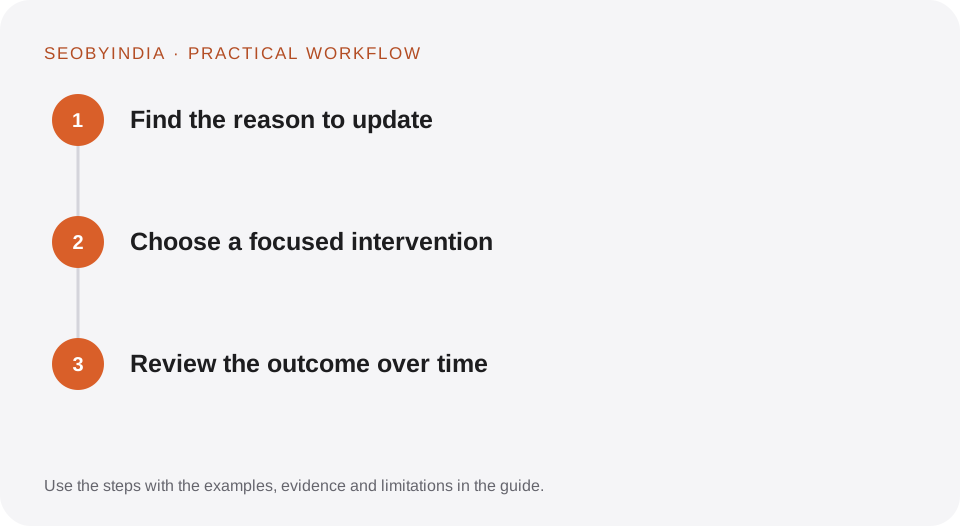
Work through the sequence below. Keep the evidence, the change you make and the acceptance check together so the next person can understand the decision.
Find the reason to update
Review customer questions, factual changes, broken references and relevant performance trends. Distinguish declining demand from a page that has become less useful.
Choose a focused intervention
Correct obsolete details, add an explanation or example, clarify the main answer or consolidate overlap. Keep a record of changes and preserve valuable URLs where practical.
Review the outcome over time
Retest links and page signals immediately. Compare relevant query and action data later using equivalent windows. Note other changes that could influence the result.
Illustrative scenario
What this looks like in practice
A guide to crawler controls is refreshed when official user-agent guidance changes. The update corrects the named agent and source link, explains the distinction from training access and records the substantive change.
This is a worked example, not a claim about a client campaign or a promised result.
Before you sign it off
Do not make an old observation appear current by changing its date. Keep historical results clearly dated and do not present them as present-day benchmarks.
Keep a useful decision record
- Purpose
- Write the customer task this change is meant to improve.
- Evidence
- Save the relevant page, source or observation and its date.
- Owner
- Identify who implements the change and who verifies it.
- Acceptance
- State what a correct result looks like before measuring its wider effect.
What to measure
Track factual gaps closed, broken references repaired, query relevance and qualified actions after the documented update.
Record the baseline and the observation window. If the measurement setup changes, annotate the report before comparing periods. Use the findings to choose the next useful improvement, rather than treating one encouraging result as proof of a permanent outcome.
Sources and further reading
These primary references provide platform guidance and context. The workflows and scenarios on this page are editorial explanations; a source link does not turn an example into a measured result.
Need help applying this?
Start with your website, target audience and the problem you want to solve. We can agree on the useful work, implementation responsibilities and reporting.
Explore the relevant serviceDiscuss the scope