
Understand the decision
A cluster works when the relationships are useful. Creating a hub with dozens of nearly identical keyword pages adds navigation without adding knowledge.
Choose an area the business can explain with expertise. State the reader’s starting point and organise the subject into real decisions or workflows.
A practical workflow
Work through the sequence below. Keep the evidence, the change you make and the acceptance check together so the next person can understand the decision.
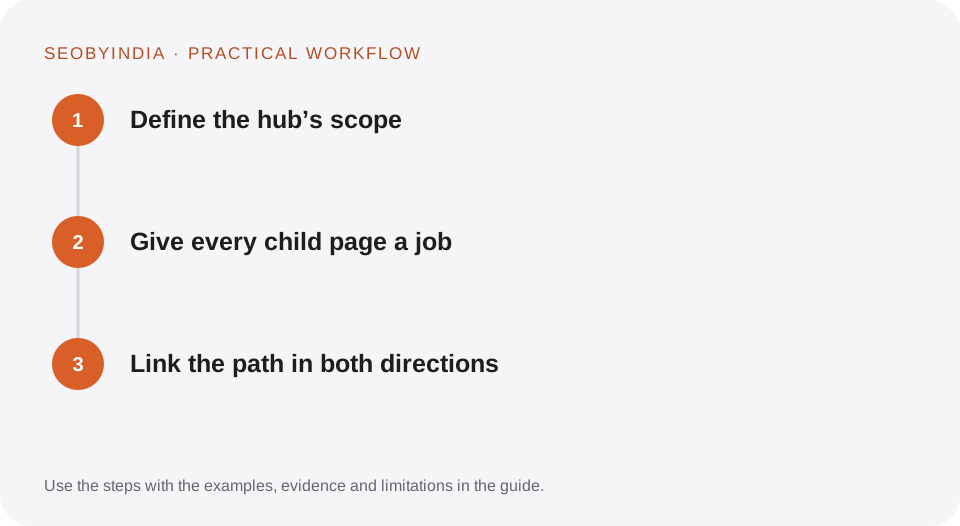
Define the hub’s scope
Choose an area the business can explain with expertise. State the reader’s starting point and organise the subject into real decisions or workflows.
Give every child page a job
Map a specific question, process or comparison to each page. Remove overlap before writing. Make the guide self-contained enough to be useful when visited directly.
Link the path in both directions
Use descriptive anchors from the hub to details and link each guide back to the hub. Add relevant sibling links where another resource answers the next likely question.
Illustrative scenario
What this looks like in practice
A technical SEO hub introduces discovery, indexing and page experience. Separate guides explain canonicals, robots, redirects and sitemaps because each involves a different implementation decision.
This is a worked example, not a claim about a client campaign or a promised result.
Before you sign it off
Do not use the same commercial keyword as the anchor for every link in the cluster. Use wording that accurately describes the destination.
Keep a useful decision record
- Purpose
- Write the customer task this change is meant to improve.
- Evidence
- Save the relevant page, source or observation and its date.
- Owner
- Identify who implements the change and who verifies it.
- Acceptance
- State what a correct result looks like before measuring its wider effect.
What to measure
Review orphan pages, overlapping intent and the usefulness of navigation paths alongside relevant search and enquiry outcomes.
Record the baseline and the observation window. If the measurement setup changes, annotate the report before comparing periods. Use the findings to choose the next useful improvement, rather than treating one encouraging result as proof of a permanent outcome.
Sources and further reading
These primary references provide platform guidance and context. The workflows and scenarios on this page are editorial explanations; a source link does not turn an example into a measured result.
Need help applying this?
Start with your website, target audience and the problem you want to solve. We can agree on the useful work, implementation responsibilities and reporting.
Explore the relevant serviceDiscuss the scope