
Understand the decision
Review effort should reflect risk and volatility. A business contact change requires a faster response than a stable explanation of a basic concept.
Record each page’s purpose, owner, sources, review trigger and business importance. Include PDFs and other downloads so their versions do not drift away from the HTML explanation.
A practical workflow
Work through the sequence below. Keep the evidence, the change you make and the acceptance check together so the next person can understand the decision.
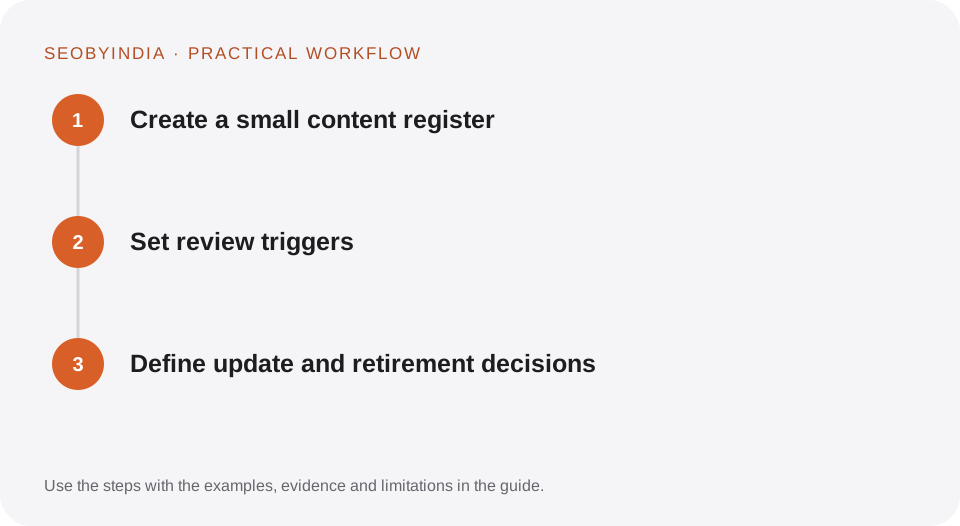
Create a small content register
Record each page’s purpose, owner, sources, review trigger and business importance. Include PDFs and other downloads so their versions do not drift away from the HTML explanation.
Set review triggers
Use material platform changes, service changes, broken references and reader feedback as signals. Schedule additional checks for time-sensitive resources without pretending every page needs a superficial weekly edit.
Define update and retirement decisions
Improve a page when its purpose remains useful. Merge overlap into a stronger destination with an appropriate redirect. Retire outdated material honestly when no relevant replacement exists.
Illustrative scenario
What this looks like in practice
A PDF audit checklist and its HTML companion share a version date. When the process changes, both are updated and the download link continues to lead to the maintained resource.
This is a worked example, not a claim about a client campaign or a promised result.
Before you sign it off
Do not leave an obsolete PDF circulating while the main page says something different. Do not remove useful established content merely to make the site look recently rebuilt.
Keep a useful decision record
- Purpose
- Write the customer task this change is meant to improve.
- Evidence
- Save the relevant page, source or observation and its date.
- Owner
- Identify who implements the change and who verifies it.
- Acceptance
- State what a correct result looks like before measuring its wider effect.
What to measure
Monitor overdue critical reviews, source-link failures, content overlap and the accuracy of downloadable companions.
Record the baseline and the observation window. If the measurement setup changes, annotate the report before comparing periods. Use the findings to choose the next useful improvement, rather than treating one encouraging result as proof of a permanent outcome.
Sources and further reading
These primary references provide platform guidance and context. The workflows and scenarios on this page are editorial explanations; a source link does not turn an example into a measured result.
Need help applying this?
Start with your website, target audience and the problem you want to solve. We can agree on the useful work, implementation responsibilities and reporting.
Explore the relevant serviceDiscuss the scope