
Understand the decision
The page must distinguish what the provider controls from what independent platforms decide. SEO implementation can be scoped; a guaranteed position for every query cannot.
Describe the business problem, included work and meaningful exclusions. State when a different service or an internal implementation team may be required.
A practical workflow
Work through the sequence below. Keep the evidence, the change you make and the acceptance check together so the next person can understand the decision.
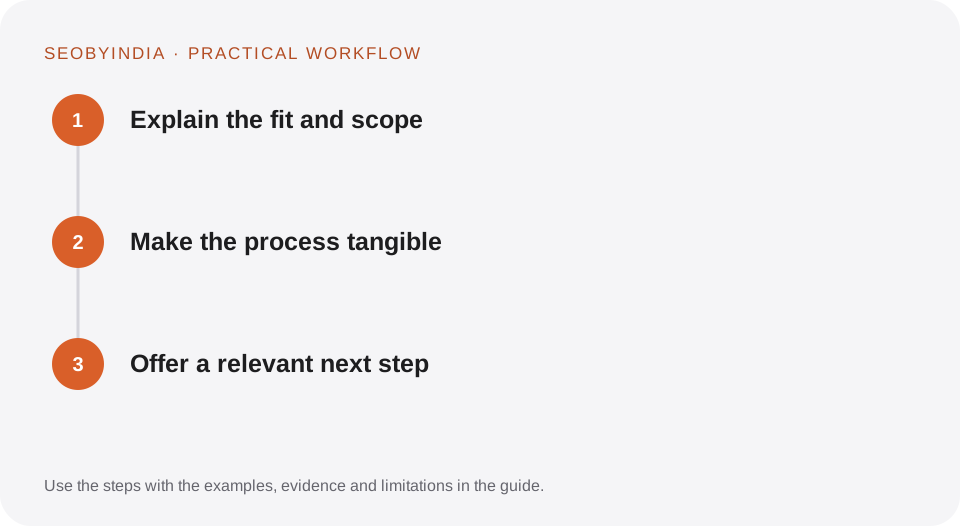
Explain the fit and scope
Describe the business problem, included work and meaningful exclusions. State when a different service or an internal implementation team may be required.
Make the process tangible
Show the information needed at the start, key deliverables, review points and responsibilities. Use an illustrative example when real client evidence is unavailable.
Offer a relevant next step
Ask for the website, target market and main goal. Explain how scope is agreed. Keep the enquiry path accessible and avoid requiring unnecessary personal information.
Illustrative scenario
What this looks like in practice
A link-building service explains prospect research, relevance checks, editorial outreach and placement verification. It distinguishes earned opportunities from sponsored arrangements and does not promise a universal ranking increase.
This is a worked example, not a claim about a client campaign or a promised result.
Before you sign it off
Do not invent testimonials, prices, guaranteed delivery times or results. Avoid a page that contains only adjectives and a contact form.
Keep a useful decision record
- Purpose
- Write the customer task this change is meant to improve.
- Evidence
- Save the relevant page, source or observation and its date.
- Owner
- Identify who implements the change and who verifies it.
- Acceptance
- State what a correct result looks like before measuring its wider effect.
What to measure
Track suitable enquiries, common pre-sale questions and where visitors need clearer scope information.
Record the baseline and the observation window. If the measurement setup changes, annotate the report before comparing periods. Use the findings to choose the next useful improvement, rather than treating one encouraging result as proof of a permanent outcome.
Sources and further reading
These primary references provide platform guidance and context. The workflows and scenarios on this page are editorial explanations; a source link does not turn an example into a measured result.
Need help applying this?
Start with your website, target audience and the problem you want to solve. We can agree on the useful work, implementation responsibilities and reporting.
Explore the relevant serviceDiscuss the scope