
Understand the decision
Publishing more creates maintenance work. A small team benefits from a clear decision about what to improve, merge, create and leave alone.
Use sales conversations, customer support, existing search queries and product knowledge. Separate questions the business can answer well from topics chosen only because a tool reports large volume.
A practical workflow
Work through the sequence below. Keep the evidence, the change you make and the acceptance check together so the next person can understand the decision.
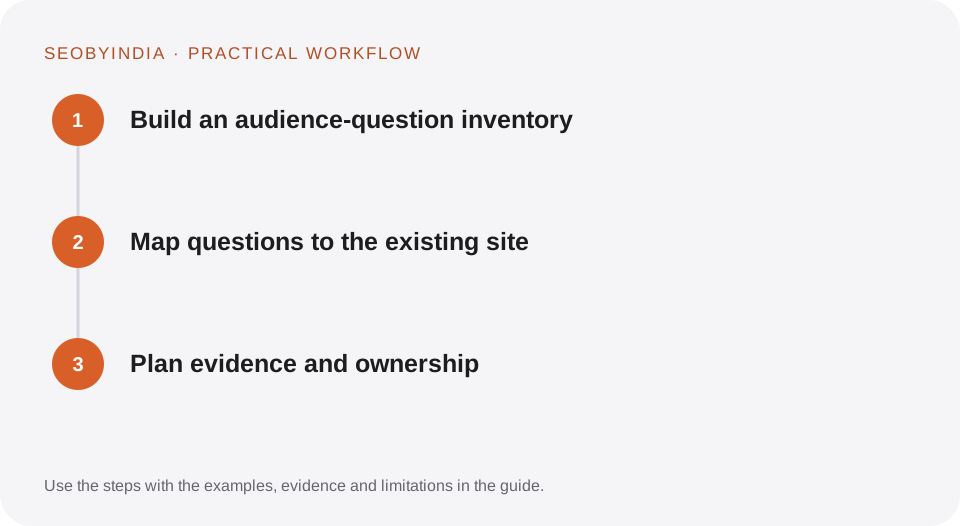
Build an audience-question inventory
Use sales conversations, customer support, existing search queries and product knowledge. Separate questions the business can answer well from topics chosen only because a tool reports large volume.
Map questions to the existing site
Identify gaps, overlapping pages and outdated information. Assign each topic a purpose and next step. Improve an established useful page when a separate article would repeat it.
Plan evidence and ownership
Give each priority a source plan, responsible person, review trigger and distribution route. Decide how success will be assessed before commissioning the page.
Illustrative scenario
What this looks like in practice
A small consultancy prioritises a clear service scope, a buying guide and a practical audit checklist before publishing daily commentary. Each resource supports a real customer decision and is linked from a relevant destination.
This is a worked example, not a claim about a client campaign or a promised result.
Before you sign it off
Do not build a publishing schedule that the team cannot fact-check or maintain. A missed weekly quota is less damaging than a library full of unsupported promises.
Keep a useful decision record
- Purpose
- Write the customer task this change is meant to improve.
- Evidence
- Save the relevant page, source or observation and its date.
- Owner
- Identify who implements the change and who verifies it.
- Acceptance
- State what a correct result looks like before measuring its wider effect.
What to measure
Track answered customer questions, useful next-step actions, relevant organic traffic and the effort required to keep priority pages accurate.
Record the baseline and the observation window. If the measurement setup changes, annotate the report before comparing periods. Use the findings to choose the next useful improvement, rather than treating one encouraging result as proof of a permanent outcome.
Sources and further reading
These primary references provide platform guidance and context. The workflows and scenarios on this page are editorial explanations; a source link does not turn an example into a measured result.
Need help applying this?
Start with your website, target audience and the problem you want to solve. We can agree on the useful work, implementation responsibilities and reporting.
Explore the relevant serviceDiscuss the scope