
Understand the decision
Useful marketing prompts prevent invented business facts and separate drafting from actions such as sending an email or publishing a page.
Describe the audience and deliverable. Include only the information needed. Mark unknown details as unknown and tell the workflow how to handle them.
A practical workflow
Work through the sequence below. Keep the evidence, the change you make and the acceptance check together so the next person can understand the decision.
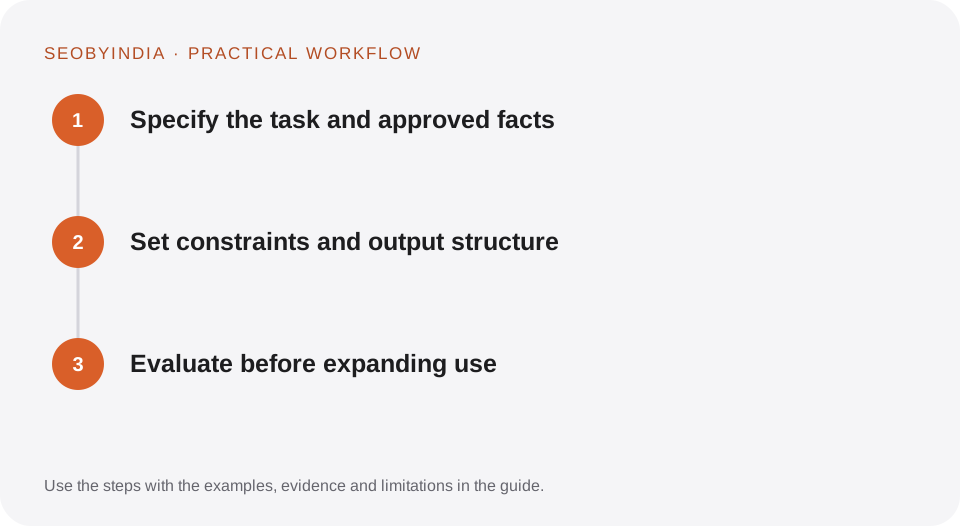
Specify the task and approved facts
Describe the audience and deliverable. Include only the information needed. Mark unknown details as unknown and tell the workflow how to handle them.
Set constraints and output structure
State what must not be claimed, what sources are allowed and what format the reviewer needs. Keep examples representative rather than showing only an easy ideal case.
Evaluate before expanding use
Test different inputs, missing information and ambiguous requests. Compare accuracy, completeness and review effort. Retain a human checkpoint before consequential external actions.
Illustrative scenario
What this looks like in practice
A content-brief prompt receives an approved service sheet and asks for an outline, unanswered questions and source requirements. When qualifications are missing, the output flags the gap rather than inventing credentials.
This is a worked example, not a claim about a client campaign or a promised result.
Before you sign it off
Do not put passwords, private client records or unnecessary sensitive information in a prompt. Do not present a local prompt builder as a live AI model.
Keep a useful decision record
- Purpose
- Write the customer task this change is meant to improve.
- Evidence
- Save the relevant page, source or observation and its date.
- Owner
- Identify who implements the change and who verifies it.
- Acceptance
- State what a correct result looks like before measuring its wider effect.
What to measure
Track factual error rate, missing-input handling, format compliance and time spent reviewing representative outputs.
Record the baseline and the observation window. If the measurement setup changes, annotate the report before comparing periods. Use the findings to choose the next useful improvement, rather than treating one encouraging result as proof of a permanent outcome.
Sources and further reading
These primary references provide platform guidance and context. The workflows and scenarios on this page are editorial explanations; a source link does not turn an example into a measured result.
Need help applying this?
Start with your website, target audience and the problem you want to solve. We can agree on the useful work, implementation responsibilities and reporting.
Explore the relevant serviceDiscuss the scope