
Understand the decision
Low-traffic sites may not support a useful test quickly. Qualitative review and fixing obvious usability failures can be more practical than running an underpowered experiment.
Explain what change should help which customer action and why. Select one primary decision measure and note guardrails such as errors or unsuitable leads.
A practical workflow
Work through the sequence below. Keep the evidence, the change you make and the acceptance check together so the next person can understand the decision.
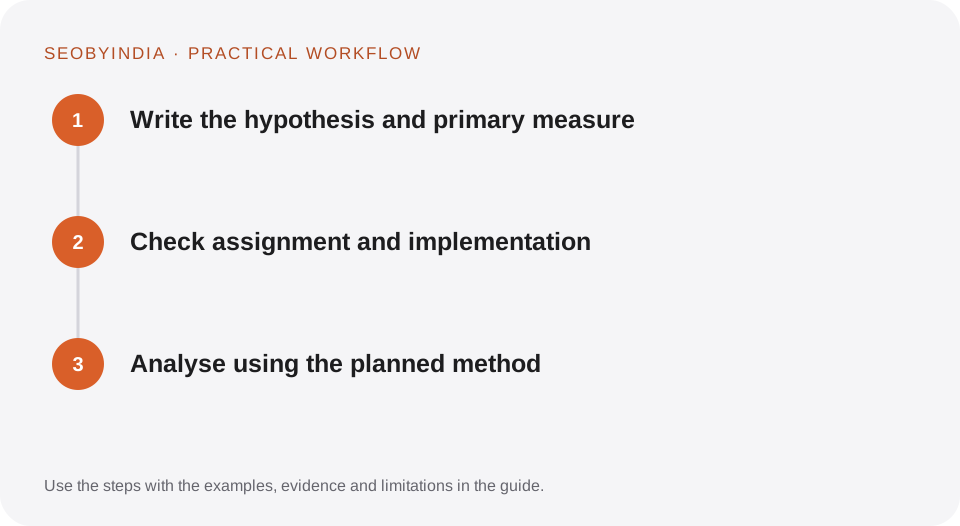
Write the hypothesis and primary measure
Explain what change should help which customer action and why. Select one primary decision measure and note guardrails such as errors or unsuitable leads.
Check assignment and implementation
Ensure versions behave as intended and measurement is comparable. Avoid exposing different factual offers unintentionally. Confirm the experience remains accessible.
Analyse using the planned method
Review sample size, uncertainty and the original stopping rule. Report inconclusive results honestly. Do not keep changing the target measure until something looks positive.
Illustrative scenario
What this looks like in practice
A service business compares two enquiry explanations while keeping the actual offer consistent. The primary outcome is a valid enquiry, with qualification reviewed as a guardrail. A short burst of extra clicks is not enough to declare success.
This is a worked example, not a claim about a client campaign or a promised result.
Before you sign it off
Do not present a small uncontrolled result as statistical proof. Do not run tests that mislead customers about prices, availability or terms.
Keep a useful decision record
- Purpose
- Write the customer task this change is meant to improve.
- Evidence
- Save the relevant page, source or observation and its date.
- Owner
- Identify who implements the change and who verifies it.
- Acceptance
- State what a correct result looks like before measuring its wider effect.
What to measure
Track the planned outcome, uncertainty, implementation errors and whether the result supports the original decision.
Record the baseline and the observation window. If the measurement setup changes, annotate the report before comparing periods. Use the findings to choose the next useful improvement, rather than treating one encouraging result as proof of a permanent outcome.
Sources and further reading
These primary references provide platform guidance and context. The workflows and scenarios on this page are editorial explanations; a source link does not turn an example into a measured result.
Need help applying this?
Start with your website, target audience and the problem you want to solve. We can agree on the useful work, implementation responsibilities and reporting.
Explore the relevant serviceDiscuss the scope