
Understand the decision
A contractor can rank for a broad home improvement term and still receive no suitable enquiries. The phrase describes an interest, but the page needs to address a service the business actually provides. Start by identifying who buys, what triggers the search and which information they need before contacting you.
Review enquiry forms, sales questions, support requests and existing Search Console queries. Separate a customer question from the terminology your team prefers. Keep the source beside each idea so a proposed topic can be traced back to a genuine need.
A practical workflow
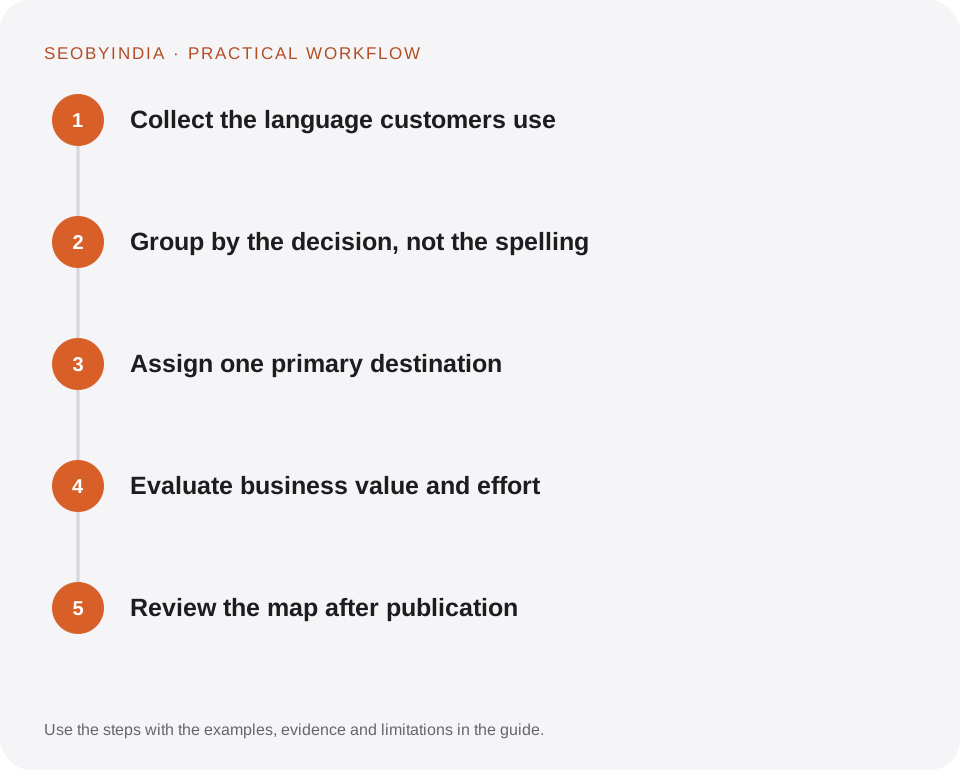
Work through the sequence below. Keep the evidence, the change you make and the acceptance check together so the next person can understand the decision.
Collect the language customers use
Review enquiry forms, sales questions, support requests and existing Search Console queries. Separate a customer question from the terminology your team prefers. Keep the source beside each idea so a proposed topic can be traced back to a genuine need.
Group by the decision, not the spelling
Put close variants together when one useful page can answer them. Compare the actual result pages and buyer expectations before splitting a cluster. A repair guide and a request for a repair provider may need separate pages even when they share a noun.
Assign one primary destination
Give every useful cluster an existing page, a planned page or a deliberate decision not to target it. Note the audience, page type, supporting questions and next action. Resolve two competing pages before creating a third.
Evaluate business value and effort
Score the fit with your services, quality of available evidence, implementation difficulty and potential customer action. Treat tool volume as directional rather than a promised audience. A lower-volume specific question can be more useful than a broad term.
Review the map after publication
Compare query impressions, landing pages and qualified enquiries. Look for irrelevant queries and questions left unanswered. Expand a page when new evidence improves its purpose; do not add a page for every keyword variation.
Illustrative scenario
What this looks like in practice
A bookkeeping firm groups bookkeeping software questions as an educational guide and monthly bookkeeping enquiries as a service page. The guide explains selection criteria and links to the service only where managed support is relevant. Each page has a distinct purpose and a measurable next step.
This is a worked example, not a claim about a client campaign or a promised result.
Before you sign it off
Creating a separate page for every singular, plural or city variation fragments the useful information. One strong page is usually a better starting point when the visitor task is the same. Never treat a keyword export as an automatic publishing queue.
Keep a useful decision record
- Purpose
- Write the customer task this change is meant to improve.
- Evidence
- Save the relevant page, source or observation and its date.
- Owner
- Identify who implements the change and who verifies it.
- Acceptance
- State what a correct result looks like before measuring its wider effect.
What to measure
Track relevant non-brand impressions, the number of queries matching the intended topic and qualified enquiries from the mapped landing page. Compare equivalent periods and annotate publication dates.
Record the baseline and the observation window. If the measurement setup changes, annotate the report before comparing periods. Use the findings to choose the next useful improvement, rather than treating one encouraging result as proof of a permanent outcome.
Sources and further reading
These primary references provide platform guidance and context. The workflows and scenarios on this page are editorial explanations; a source link does not turn an example into a measured result.
Need help applying this?
Start with your website, target audience and the problem you want to solve. We can agree on the useful work, implementation responsibilities and reporting.
Explore the relevant serviceDiscuss the scope