
Understand the decision
Aggressive anchor requirements can make outreach less editorial and can create unnatural patterns. Let context guide the wording and do not disguise the nature of a paid relationship.
Use wording that accurately represents the linked page. A guide, checklist and provider homepage serve different tasks and should not all receive the same anchor.
A practical workflow
Work through the sequence below. Keep the evidence, the change you make and the acceptance check together so the next person can understand the decision.
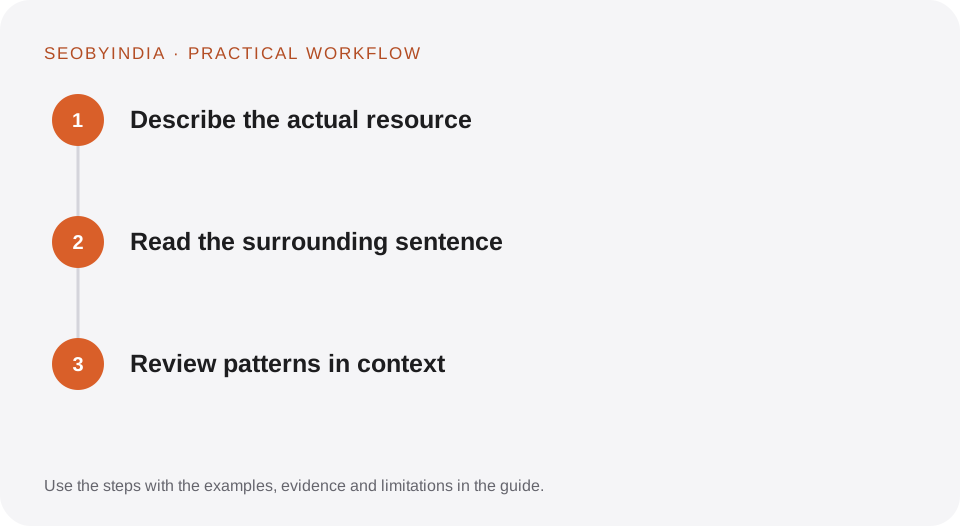
Describe the actual resource
Use wording that accurately represents the linked page. A guide, checklist and provider homepage serve different tasks and should not all receive the same anchor.
Read the surrounding sentence
Check that the link adds information where the reader needs it. Avoid a sentence built only to hold a target keyword.
Review patterns in context
Look across campaigns for repeated commercial wording, irrelevant pages and arrangements made solely for ranking manipulation. Respect the publisher’s editorial judgement.
Illustrative scenario
What this looks like in practice
An article discussing canonical problems links with the phrase canonical URL guide to a detailed explanation. A business citation may naturally use the brand name instead. Neither needs to force several service keywords into one link.
This is a worked example, not a claim about a client campaign or a promised result.
Before you sign it off
There is no universally safe anchor ratio that makes a manipulative campaign acceptable. Do not treat percentage targets as permission to buy unnatural links.
Keep a useful decision record
- Purpose
- Write the customer task this change is meant to improve.
- Evidence
- Save the relevant page, source or observation and its date.
- Owner
- Identify who implements the change and who verifies it.
- Acceptance
- State what a correct result looks like before measuring its wider effect.
What to measure
Review contextual accuracy, target relevance and suspicious concentration, while recording the limitations of backlink datasets.
Record the baseline and the observation window. If the measurement setup changes, annotate the report before comparing periods. Use the findings to choose the next useful improvement, rather than treating one encouraging result as proof of a permanent outcome.
Sources and further reading
These primary references provide platform guidance and context. The workflows and scenarios on this page are editorial explanations; a source link does not turn an example into a measured result.
Need help applying this?
Start with your website, target audience and the problem you want to solve. We can agree on the useful work, implementation responsibilities and reporting.
Explore the relevant serviceDiscuss the scope