
Understand the decision
A high metric can distract from an irrelevant audience or a site whose articles exist mainly to sell links. Evaluate the relationship between the publication, the article and the proposed reference.
Read several recent articles and check the editorial focus, authorship, navigation and business identity. Look for a genuine audience and consistent topic coverage rather than a large assortment of unrelated commercial posts.
A practical workflow
Work through the sequence below. Keep the evidence, the change you make and the acceptance check together so the next person can understand the decision.
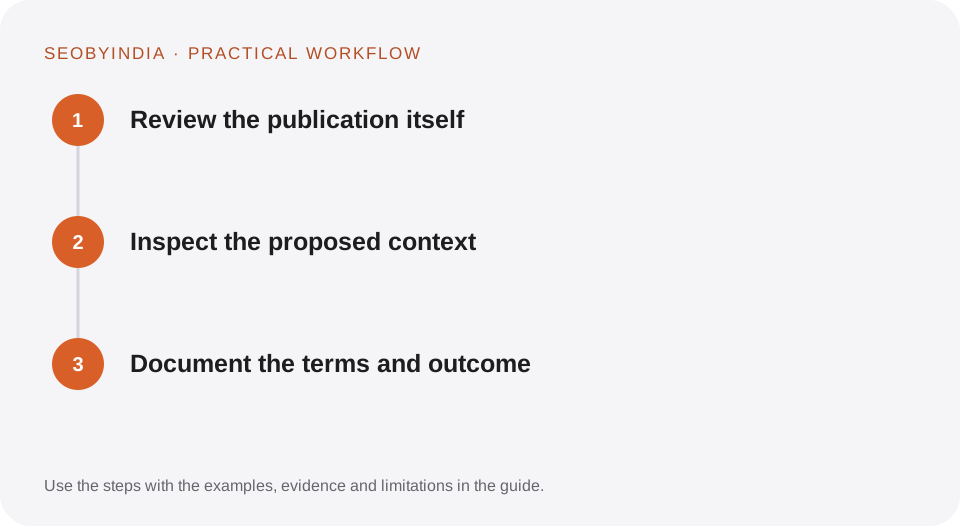
Review the publication itself
Read several recent articles and check the editorial focus, authorship, navigation and business identity. Look for a genuine audience and consistent topic coverage rather than a large assortment of unrelated commercial posts.
Inspect the proposed context
Ask why this article would refer to the destination. Check the surrounding paragraph, anchor, placement and reader benefit. A relevant domain does not make every page on it relevant.
Document the terms and outcome
Record whether the opportunity is editorial, sponsored or another relationship. Paid links should use appropriate disclosure and link attributes. Confirm the live destination and context after publication.
Illustrative scenario
What this looks like in practice
A property-management publication references a detailed tenant-screening guide while explaining application preparation. The reference gives readers a useful next step. A generic article on an unrelated site with a stronger metric would not provide the same contextual value.
This is a worked example, not a claim about a client campaign or a promised result.
Before you sign it off
Do not promise that a specific domain metric creates a ranking increase. Avoid private link networks, fabricated traffic claims and undisclosed paid links intended to manipulate rankings.
Keep a useful decision record
- Purpose
- Write the customer task this change is meant to improve.
- Evidence
- Save the relevant page, source or observation and its date.
- Owner
- Identify who implements the change and who verifies it.
- Acceptance
- State what a correct result looks like before measuring its wider effect.
What to measure
Track qualified editorial opportunities, relevant live references, referral quality and business outcomes. Record the limitations of third-party estimates.
Record the baseline and the observation window. If the measurement setup changes, annotate the report before comparing periods. Use the findings to choose the next useful improvement, rather than treating one encouraging result as proof of a permanent outcome.
Sources and further reading
These primary references provide platform guidance and context. The workflows and scenarios on this page are editorial explanations; a source link does not turn an example into a measured result.
Need help applying this?
Start with your website, target audience and the problem you want to solve. We can agree on the useful work, implementation responsibilities and reporting.
Explore the relevant serviceDiscuss the scope