
Understand the decision
An editor needs a reason to care about the proposal, not a long paragraph of compliments. Be specific about the story, supporting material and what can be provided.
Read the relevant article or section and identify an unanswered question or complementary angle. Save the reference so the proposal is grounded in something real.
A practical workflow
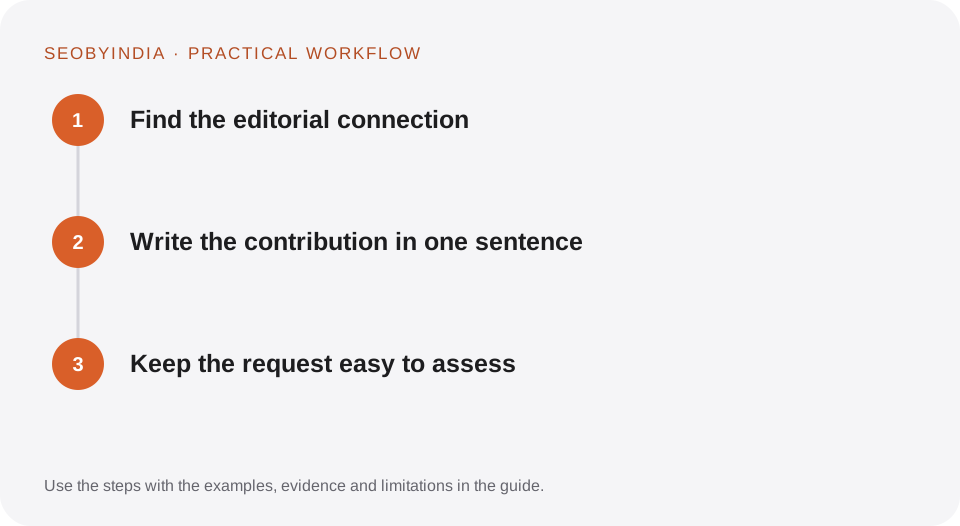
Work through the sequence below. Keep the evidence, the change you make and the acceptance check together so the next person can understand the decision.
Find the editorial connection
Read the relevant article or section and identify an unanswered question or complementary angle. Save the reference so the proposal is grounded in something real.
Write the contribution in one sentence
State what is new, useful or practically relevant. Explain what evidence, expertise or example supports it. Avoid exaggerated claims about guaranteed audience value.
Keep the request easy to assess
Offer a concise outline, sample finding or source summary. Use a clear next step. Make it easy for the recipient to decline and record that decision respectfully.
Illustrative scenario
What this looks like in practice
Instead of asking for a backlink in any article, a specialist offers a short explanation of a documented maintenance issue that follows naturally from the publication’s recent guide. The message states what the contribution adds and links to the supporting material.
This is a worked example, not a claim about a client campaign or a promised result.
Before you sign it off
Do not claim to be a devoted reader when the only research was the page title. Avoid fabricated familiarity or misleading subject lines.
Keep a useful decision record
- Purpose
- Write the customer task this change is meant to improve.
- Evidence
- Save the relevant page, source or observation and its date.
- Owner
- Identify who implements the change and who verifies it.
- Acceptance
- State what a correct result looks like before measuring its wider effect.
What to measure
Review relevant replies, editorial questions and accepted angles. Compare results by contribution type rather than superficial word changes.
Record the baseline and the observation window. If the measurement setup changes, annotate the report before comparing periods. Use the findings to choose the next useful improvement, rather than treating one encouraging result as proof of a permanent outcome.
Sources and further reading
These primary references provide platform guidance and context. The workflows and scenarios on this page are editorial explanations; a source link does not turn an example into a measured result.
Need help applying this?
Start with your website, target audience and the problem you want to solve. We can agree on the useful work, implementation responsibilities and reporting.
Explore the relevant serviceDiscuss the scope