
Understand the decision
A useful angle connects the business’s expertise to a reader problem and supplies evidence an editor can assess. Avoid inventing statistics or stretching a weak connection to a trend.
List original observations, documented processes, public data analysis and subject expertise. Check what can be published without exposing private client information.
A practical workflow
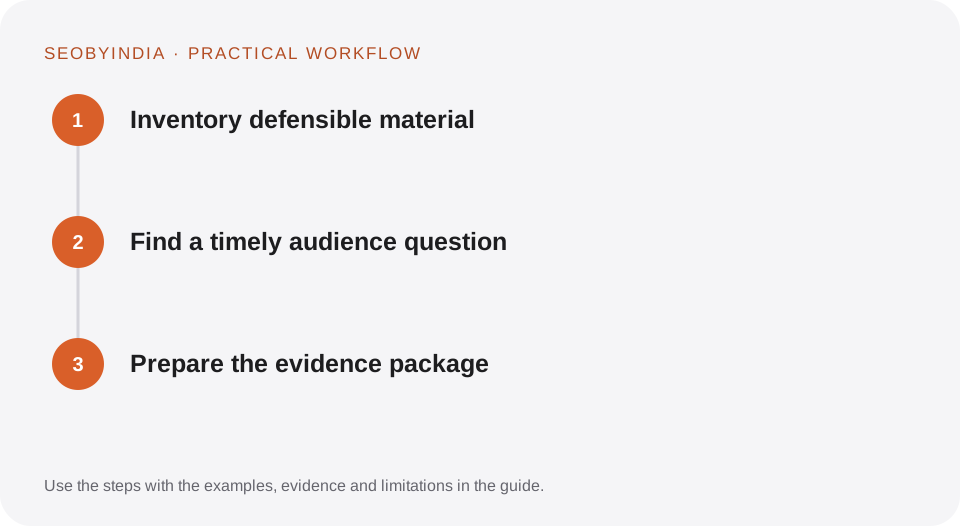
Work through the sequence below. Keep the evidence, the change you make and the acceptance check together so the next person can understand the decision.
Inventory defensible material
List original observations, documented processes, public data analysis and subject expertise. Check what can be published without exposing private client information.
Find a timely audience question
Review the publication’s coverage and identify a decision or issue the material can illuminate. Explain the relevance in plain language without claiming every topic is breaking news.
Prepare the evidence package
Provide the finding, method, limitations and an appropriate spokesperson description. Make source documents easy to inspect. Separate measured results from estimates and opinions.
Illustrative scenario
What this looks like in practice
A maintenance business analyses an anonymised, consented set of common repair requests and explains seasonal preparation. The proposal includes the sample window and limitations instead of claiming the data represents every home in the country.
This is a worked example, not a claim about a client campaign or a promised result.
Before you sign it off
Do not manufacture a sensational statistic from a tiny unrepresentative sample. Protect client confidentiality and do not invent quotations.
Keep a useful decision record
- Purpose
- Write the customer task this change is meant to improve.
- Evidence
- Save the relevant page, source or observation and its date.
- Owner
- Identify who implements the change and who verifies it.
- Acceptance
- State what a correct result looks like before measuring its wider effect.
What to measure
Measure editorial relevance, qualified coverage, accurate reporting of the findings and referral or enquiry quality.
Record the baseline and the observation window. If the measurement setup changes, annotate the report before comparing periods. Use the findings to choose the next useful improvement, rather than treating one encouraging result as proof of a permanent outcome.
Sources and further reading
These primary references provide platform guidance and context. The workflows and scenarios on this page are editorial explanations; a source link does not turn an example into a measured result.
Need help applying this?
Start with your website, target audience and the problem you want to solve. We can agree on the useful work, implementation responsibilities and reporting.
Explore the relevant serviceDiscuss the scope