
Understand the decision
Search results and databases can identify candidates, but every candidate still needs contextual review. Do not assume a site accepts contributions because it has published a guest article in the past.
Write the reader problem, your relevant expertise and the format you can provide. Decide what evidence or original material makes the proposal worth an editor’s time.
A practical workflow
Work through the sequence below. Keep the evidence, the change you make and the acceptance check together so the next person can understand the decision.
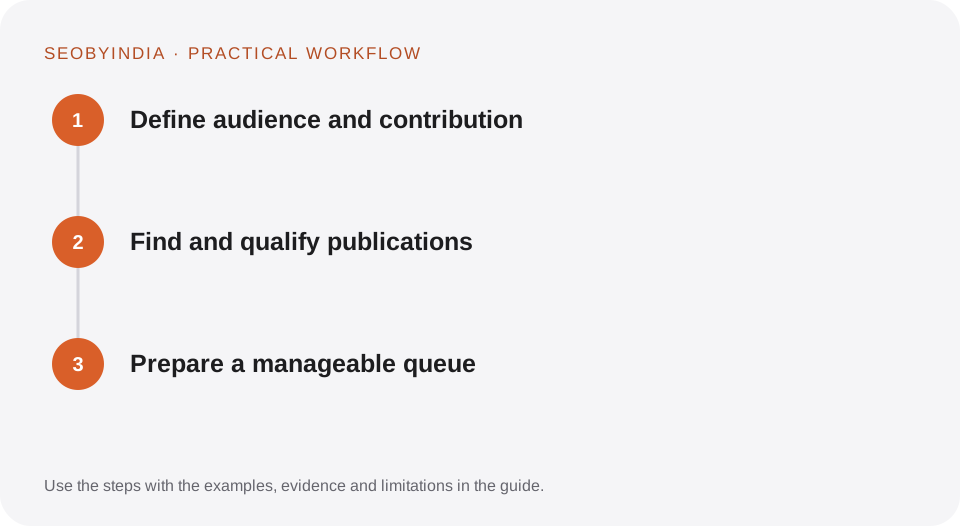
Define audience and contribution
Write the reader problem, your relevant expertise and the format you can provide. Decide what evidence or original material makes the proposal worth an editor’s time.
Find and qualify publications
Search relevant topics, inspect sources already cited in useful articles and review publication sections. Record current editorial fit, recent examples and the reason each candidate belongs on the list.
Prepare a manageable queue
Keep a public contact route, evidence URL, proposed angle, status and next action. Remove duplicates and declined contacts. Personalise from actual editorial context instead of merely changing the domain name.
Illustrative scenario
What this looks like in practice
For a local-commerce research piece, the queue separates retail trade publications, small-business outlets and local technology reporting. Each group receives a distinct relevant angle supported by the same documented research.
This is a worked example, not a claim about a client campaign or a promised result.
Before you sign it off
Do not scrape personal addresses from unrelated sources or fabricate an editor’s name. Prefer published professional contact routes and respect opt-outs.
Keep a useful decision record
- Purpose
- Write the customer task this change is meant to improve.
- Evidence
- Save the relevant page, source or observation and its date.
- Owner
- Identify who implements the change and who verifies it.
- Acceptance
- State what a correct result looks like before measuring its wider effect.
What to measure
Measure qualified prospects, proportion with documented editorial fit, useful replies and accepted contributions rather than the size of the raw list.
Record the baseline and the observation window. If the measurement setup changes, annotate the report before comparing periods. Use the findings to choose the next useful improvement, rather than treating one encouraging result as proof of a permanent outcome.
Sources and further reading
These primary references provide platform guidance and context. The workflows and scenarios on this page are editorial explanations; a source link does not turn an example into a measured result.
Need help applying this?
Start with your website, target audience and the problem you want to solve. We can agree on the useful work, implementation responsibilities and reporting.
Explore the relevant serviceDiscuss the scope