
Understand the decision
A verified email address is not the same as a suitable recipient. The person’s role, beat and current publication matter as much as deliverability.
Review the contact page, masthead and contribution instructions. Note what kinds of proposals are accepted and whether the publication asks for a form or a particular section inbox.
A practical workflow
Work through the sequence below. Keep the evidence, the change you make and the acceptance check together so the next person can understand the decision.
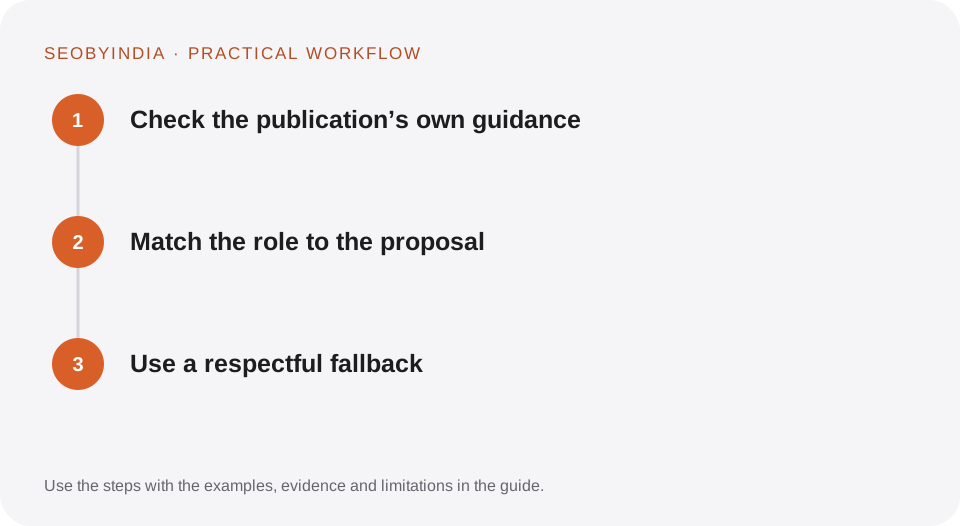
Check the publication’s own guidance
Review the contact page, masthead and contribution instructions. Note what kinds of proposals are accepted and whether the publication asks for a form or a particular section inbox.
Match the role to the proposal
Use recent relevant work to understand the person’s coverage. Confirm that the person still appears connected to the publication. Keep the evidence link and research date beside the contact.
Use a respectful fallback
If there is no clear individual match, use the published editorial or submissions route. Explain the contribution briefly and ask whether it belongs with that desk. Keep declined and opt-out contacts out of future queues.
Illustrative scenario
What this looks like in practice
A proposal about building maintenance goes to the publication’s property or facilities desk rather than a journalist whose only matching article was written years earlier for a different employer.
This is a worked example, not a claim about a client campaign or a promised result.
Before you sign it off
Do not infer private personal email addresses from naming patterns and label them verified. Do not use irrelevant recipients simply because their details are available.
Keep a useful decision record
- Purpose
- Write the customer task this change is meant to improve.
- Evidence
- Save the relevant page, source or observation and its date.
- Owner
- Identify who implements the change and who verifies it.
- Acceptance
- State what a correct result looks like before measuring its wider effect.
What to measure
Track role accuracy, relevant responses, routing corrections and opt-out handling. Deliverability alone does not prove research quality.
Record the baseline and the observation window. If the measurement setup changes, annotate the report before comparing periods. Use the findings to choose the next useful improvement, rather than treating one encouraging result as proof of a permanent outcome.
Sources and further reading
These primary references provide platform guidance and context. The workflows and scenarios on this page are editorial explanations; a source link does not turn an example into a measured result.
Need help applying this?
Start with your website, target audience and the problem you want to solve. We can agree on the useful work, implementation responsibilities and reporting.
Explore the relevant serviceDiscuss the scope