
Understand the decision
A screenshot of an email approval is not proof that a link is available to readers. Check the published page itself and revisit important placements when appropriate.
Confirm the correct publication, article and accessible content. Read the relevant passage and make sure it does not misrepresent the business or the resource.
A practical workflow
Work through the sequence below. Keep the evidence, the change you make and the acceptance check together so the next person can understand the decision.
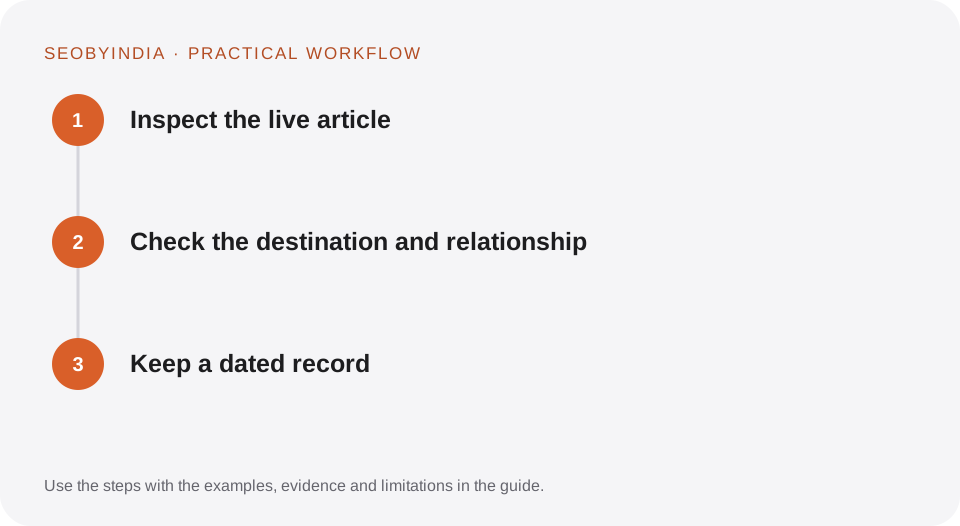
Inspect the live article
Confirm the correct publication, article and accessible content. Read the relevant passage and make sure it does not misrepresent the business or the resource.
Check the destination and relationship
Follow the link, confirm the intended final URL and inspect sponsored or nofollow treatment as relevant. Check visible disclosure and whether the destination still fulfils the reference.
Keep a dated record
Store the public article URL, destination, context and verification date. Record corrections and later changes. Avoid guaranteeing that an independent publisher will maintain a placement forever.
Illustrative scenario
What this looks like in practice
A live article links to a misspelled path. The verifier identifies the broken destination and sends a concise correction request with the intended URL. The campaign is not marked complete until the actual outcome is recorded.
This is a worked example, not a claim about a client campaign or a promised result.
Before you sign it off
Do not hide an inaccessible article or wrong target behind a successful outreach count. Report pending corrections and unverifiable claims clearly.
Keep a useful decision record
- Purpose
- Write the customer task this change is meant to improve.
- Evidence
- Save the relevant page, source or observation and its date.
- Owner
- Identify who implements the change and who verifies it.
- Acceptance
- State what a correct result looks like before measuring its wider effect.
What to measure
Track accurate live placements, broken targets, disclosed relationships and follow-up corrections.
Record the baseline and the observation window. If the measurement setup changes, annotate the report before comparing periods. Use the findings to choose the next useful improvement, rather than treating one encouraging result as proof of a permanent outcome.
Sources and further reading
These primary references provide platform guidance and context. The workflows and scenarios on this page are editorial explanations; a source link does not turn an example into a measured result.
Need help applying this?
Start with your website, target audience and the problem you want to solve. We can agree on the useful work, implementation responsibilities and reporting.
Explore the relevant serviceDiscuss the scope