
Understand the decision
Buying advertising can be a legitimate way to reach an audience. It should not be sold as a guaranteed transfer of ranking value or hidden from the reader.
Agree on the content format, publication process, disclosure, duration and any rights or responsibilities. Do not promise an editor’s independent endorsement as part of a paid package.
A practical workflow
Work through the sequence below. Keep the evidence, the change you make and the acceptance check together so the next person can understand the decision.
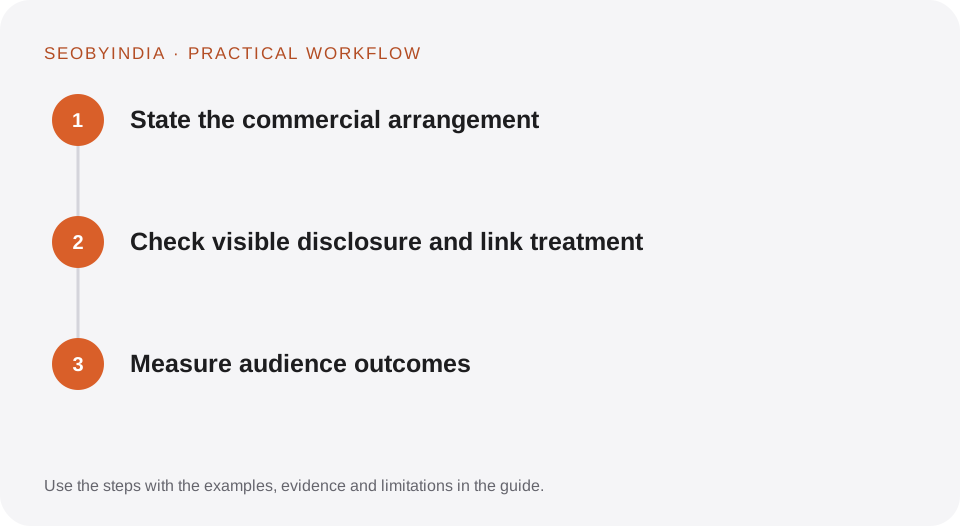
State the commercial arrangement
Agree on the content format, publication process, disclosure, duration and any rights or responsibilities. Do not promise an editor’s independent endorsement as part of a paid package.
Check visible disclosure and link treatment
Confirm the live page communicates sponsorship appropriately and uses the relevant link attributes. Review current platform guidance and any applicable advertising requirements with appropriate expertise.
Measure audience outcomes
Assess reach, referral engagement and suitable enquiries. Keep the advertising result separate from unsupported claims about search-engine authority.
Illustrative scenario
What this looks like in practice
A business sponsors a relevant trade article. The relationship is disclosed and the links are qualified. The campaign report focuses on the audience reached and the quality of visits instead of promising a ranking increase.
This is a worked example, not a claim about a client campaign or a promised result.
Before you sign it off
Do not negotiate removal of disclosure or paid-link qualification solely to influence rankings. Do not describe a paid mention as independent earned media.
Keep a useful decision record
- Purpose
- Write the customer task this change is meant to improve.
- Evidence
- Save the relevant page, source or observation and its date.
- Owner
- Identify who implements the change and who verifies it.
- Acceptance
- State what a correct result looks like before measuring its wider effect.
What to measure
Track accurate disclosure, relevant referral traffic, qualified actions and adherence to the agreed publication terms.
Record the baseline and the observation window. If the measurement setup changes, annotate the report before comparing periods. Use the findings to choose the next useful improvement, rather than treating one encouraging result as proof of a permanent outcome.
Sources and further reading
These primary references provide platform guidance and context. The workflows and scenarios on this page are editorial explanations; a source link does not turn an example into a measured result.
Need help applying this?
Start with your website, target audience and the problem you want to solve. We can agree on the useful work, implementation responsibilities and reporting.
Explore the relevant serviceDiscuss the scope