
Understand the decision
Different claims need different support. A platform rule should point to official guidance; an original result needs a method and timeframe; a hypothetical example should be labelled as illustrative.
Use a truthful biography and relevant background. Avoid implying that a person reviewed a page when they have not. Disclose meaningful AI assistance where it helps readers understand how the material was prepared.
A practical workflow
Work through the sequence below. Keep the evidence, the change you make and the acceptance check together so the next person can understand the decision.
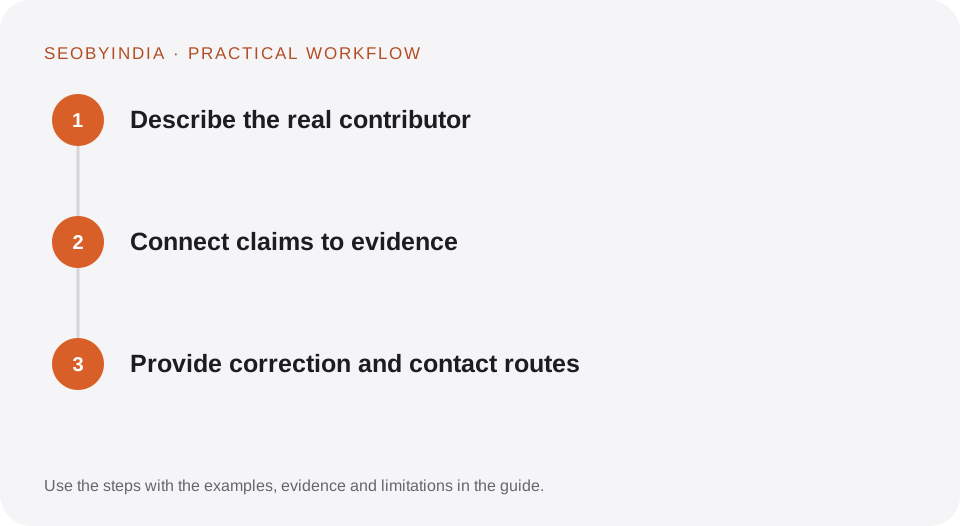
Describe the real contributor
Use a truthful biography and relevant background. Avoid implying that a person reviewed a page when they have not. Disclose meaningful AI assistance where it helps readers understand how the material was prepared.
Connect claims to evidence
Link supporting sources close to the relevant explanation. For experience-based advice, describe the context and limitations without revealing confidential client information.
Provide correction and contact routes
Make it easy to identify the business and report an error. Update important inaccuracies and keep the page’s claims aligned with the actual service.
Illustrative scenario
What this looks like in practice
An independent specialist describes documented SEO and outreach experience while a resource states that it was prepared with AI assistance. It does not claim Google certification, a named client endorsement or human review without evidence.
This is a worked example, not a claim about a client campaign or a promised result.
Before you sign it off
Do not fabricate an editorial team, office network, review score or client logo wall. Remove claims that cannot be supported.
Keep a useful decision record
- Purpose
- Write the customer task this change is meant to improve.
- Evidence
- Save the relevant page, source or observation and its date.
- Owner
- Identify who implements the change and who verifies it.
- Acceptance
- State what a correct result looks like before measuring its wider effect.
What to measure
Track factual corrections, source quality, accurate authorship and the completeness of important business information.
Record the baseline and the observation window. If the measurement setup changes, annotate the report before comparing periods. Use the findings to choose the next useful improvement, rather than treating one encouraging result as proof of a permanent outcome.
Sources and further reading
These primary references provide platform guidance and context. The workflows and scenarios on this page are editorial explanations; a source link does not turn an example into a measured result.
Need help applying this?
Start with your website, target audience and the problem you want to solve. We can agree on the useful work, implementation responsibilities and reporting.
Explore the relevant serviceDiscuss the scope