
Understand the decision
A marketing channel can influence a decision without being its only cause. Use an agreed attribution approach and describe what the available evidence can support.
Choose the business outcome and include the relevant delivery, media, content and internal costs. Label incomplete cost information rather than presenting a partial figure as a full return.
A practical workflow
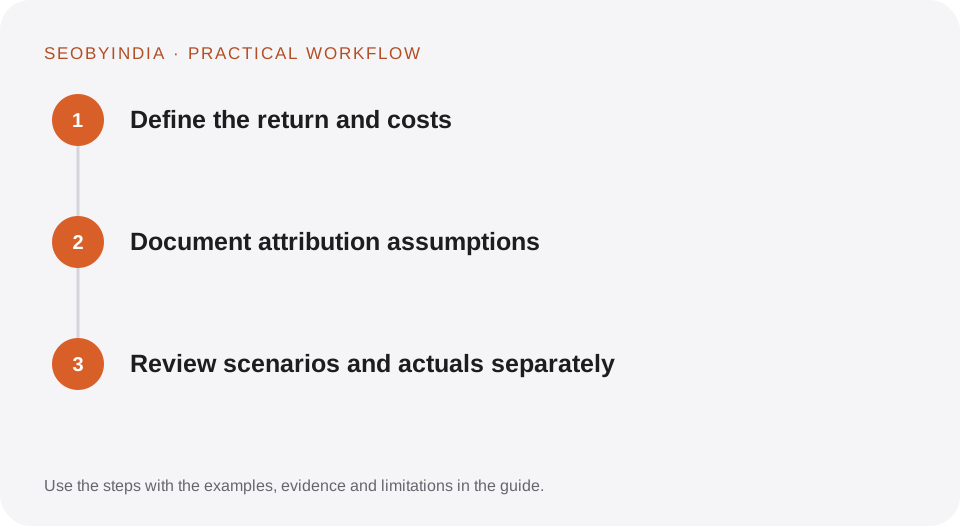
Work through the sequence below. Keep the evidence, the change you make and the acceptance check together so the next person can understand the decision.
Define the return and costs
Choose the business outcome and include the relevant delivery, media, content and internal costs. Label incomplete cost information rather than presenting a partial figure as a full return.
Document attribution assumptions
Explain how an enquiry or sale is assigned to the campaign. Separate directly observed sources from self-reported and modelled contributions.
Review scenarios and actuals separately
Use estimates for planning and observed business records for retrospective reporting where available. Account for the timing between marketing work and completed business.
Illustrative scenario
What this looks like in practice
A report shows campaign cost and attributed gross profit using an agreed method, while separately recording sales still in progress. It does not call all revenue from customers who visited a guide the exclusive result of that page.
This is a worked example, not a claim about a client campaign or a promised result.
Before you sign it off
Do not confuse revenue-to-cost ratio with profit-based ROI. Do not hide uncertain attribution behind a precise percentage.
Keep a useful decision record
- Purpose
- Write the customer task this change is meant to improve.
- Evidence
- Save the relevant page, source or observation and its date.
- Owner
- Identify who implements the change and who verifies it.
- Acceptance
- State what a correct result looks like before measuring its wider effect.
What to measure
Track agreed return, complete relevant costs, attribution coverage and the difference between planning estimates and observed outcomes.
Record the baseline and the observation window. If the measurement setup changes, annotate the report before comparing periods. Use the findings to choose the next useful improvement, rather than treating one encouraging result as proof of a permanent outcome.
Sources and further reading
These primary references provide platform guidance and context. The workflows and scenarios on this page are editorial explanations; a source link does not turn an example into a measured result.
Need help applying this?
Start with your website, target audience and the problem you want to solve. We can agree on the useful work, implementation responsibilities and reporting.
Explore the relevant serviceDiscuss the scope