
Understand the decision
A page that answers what SEO means will not automatically satisfy someone comparing specialist support. The difference is the depth of commercial detail required: scope, responsibilities, evidence, process and an appropriate enquiry route.
Restate the query as a first-person need. Include the audience and the decision they will make next. Avoid labels such as informational that hide what the visitor actually needs to understand.
A practical workflow
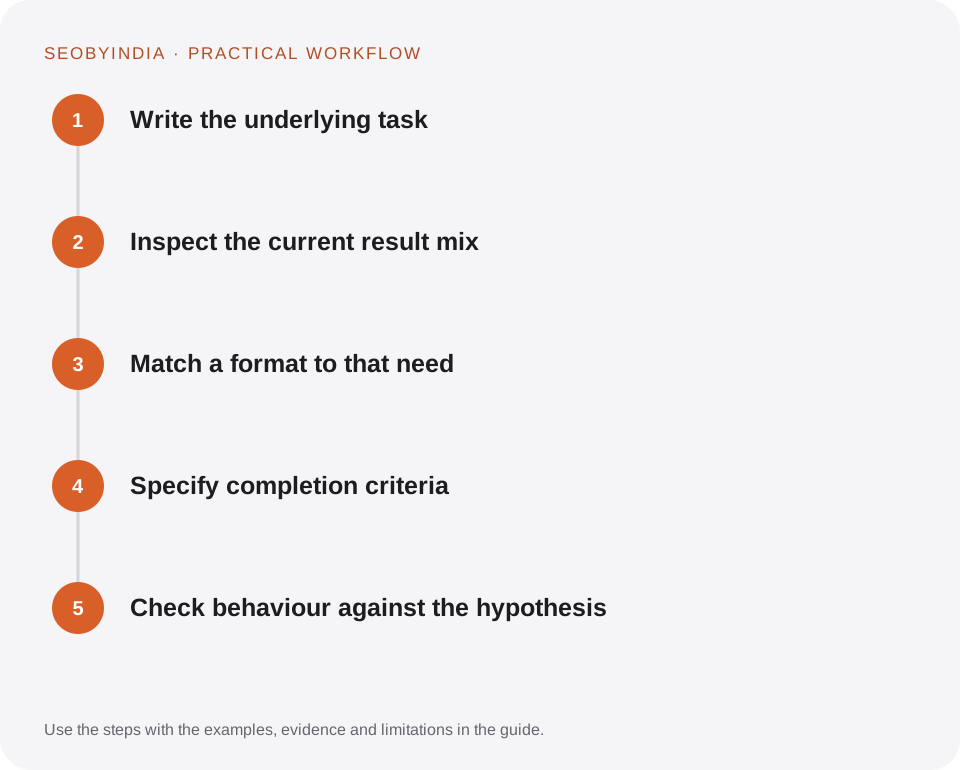
Work through the sequence below. Keep the evidence, the change you make and the acceptance check together so the next person can understand the decision.
Write the underlying task
Restate the query as a first-person need. Include the audience and the decision they will make next. Avoid labels such as informational that hide what the visitor actually needs to understand.
Inspect the current result mix
Review several results and note the formats, questions, buying context and date sensitivity. A result page is evidence of likely expectations, not an instruction to copy the leading article.
Match a format to that need
Use a guide for explanation, a comparison for selection criteria, a service page for delivery and a tool for calculation. Put the direct answer or main offer before secondary background.
Specify completion criteria
List what a visitor should know or be able to do after reading. Include constraints and exceptions. A comparison is incomplete when it lists features without explaining which trade-offs matter.
Check behaviour against the hypothesis
Review relevant queries and the actions visitors take. A high exit rate can mean a question was answered; judge it alongside task completion rather than calling every exit a failure.
Illustrative scenario
What this looks like in practice
For SEO audit cost, a useful page explains what changes the fee, what an audit includes, how implementation differs from diagnosis and what information a provider needs to quote. It avoids pretending there is one universal price.
This is a worked example, not a claim about a client campaign or a promised result.
Before you sign it off
Do not force a commercial form above the answer on every educational page. Keep the next step relevant and let the page satisfy the original question first.
Keep a useful decision record
- Purpose
- Write the customer task this change is meant to improve.
- Evidence
- Save the relevant page, source or observation and its date.
- Owner
- Identify who implements the change and who verifies it.
- Acceptance
- State what a correct result looks like before measuring its wider effect.
What to measure
Review intent-matched impressions, clicks to a related next step and the quality of resulting enquiries. Query relevance matters more than ranking for an unrelated popular phrase.
Record the baseline and the observation window. If the measurement setup changes, annotate the report before comparing periods. Use the findings to choose the next useful improvement, rather than treating one encouraging result as proof of a permanent outcome.
Sources and further reading
These primary references provide platform guidance and context. The workflows and scenarios on this page are editorial explanations; a source link does not turn an example into a measured result.
Need help applying this?
Start with your website, target audience and the problem you want to solve. We can agree on the useful work, implementation responsibilities and reporting.
Explore the relevant serviceDiscuss the scope