
Understand the decision
Problems arise when plugins emit conflicting graphs or when copied markup invents reviews, prices or an author. Establish one owner for the primary site graph and add only the additional entities needed for the actual page.
Distinguish an organisation, person, article, service and breadcrumb trail. Choose types that describe the real content rather than the search feature you hope to obtain.
A practical workflow
Work through the sequence below. Keep the evidence, the change you make and the acceptance check together so the next person can understand the decision.
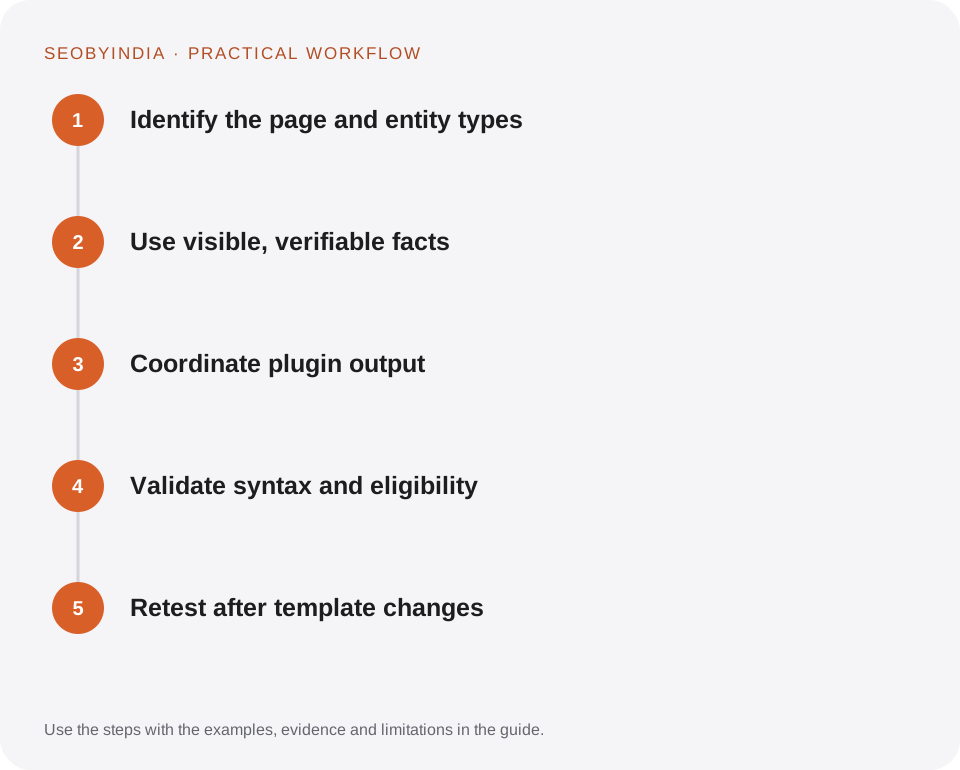
Identify the page and entity types
Distinguish an organisation, person, article, service and breadcrumb trail. Choose types that describe the real content rather than the search feature you hope to obtain.
Use visible, verifiable facts
Match names, URLs, descriptions and authorship to the page. Do not invent ratings, offices, credentials or service prices for the sake of completing a schema example.
Coordinate plugin output
Inspect the final graph from the SEO plugin and theme. Reuse consistent identifiers for the same organisation and avoid duplicate primary entities with contradictory details.
Validate syntax and eligibility
Check that the JSON parses and that relevant properties are correct. Use the platform’s official validation tools for supported features. A valid generic schema type may not qualify for a Google rich result.
Retest after template changes
Check a page from each content type. Maintain the markup when the visible content changes. Remove unsupported claims rather than hiding them from the page.
Illustrative scenario
What this looks like in practice
A service page describes SEO consultation and includes a Service entity with the same name and provider. An educational article uses a factual author and publication date. Neither page adds a fabricated five-star rating.
This is a worked example, not a claim about a client campaign or a promised result.
Before you sign it off
Do not add FAQ or review markup solely because a plugin offers it. The content and the search platform’s eligibility rules still apply.
Keep a useful decision record
- Purpose
- Write the customer task this change is meant to improve.
- Evidence
- Save the relevant page, source or observation and its date.
- Owner
- Identify who implements the change and who verifies it.
- Acceptance
- State what a correct result looks like before measuring its wider effect.
What to measure
Track validation errors, contradictory entities and supported enhancement reports. Keep rich-result appearance separate from implementation success.
Record the baseline and the observation window. If the measurement setup changes, annotate the report before comparing periods. Use the findings to choose the next useful improvement, rather than treating one encouraging result as proof of a permanent outcome.
Sources and further reading
These primary references provide platform guidance and context. The workflows and scenarios on this page are editorial explanations; a source link does not turn an example into a measured result.
Need help applying this?
Start with your website, target audience and the problem you want to solve. We can agree on the useful work, implementation responsibilities and reporting.
Explore the relevant serviceDiscuss the scope